Monday, July 14, 2014

Saturday, July 12, 2014

Friday, July 11, 2014
Thursday, July 10, 2014
Essentials of Islam — Articles of Belief

Assalam Walaikum.
In the last article we discussed the essence, importance and transmission of knowledge along with the fundamentals of Faith as recorded in the Hadith of Gabriel. In this article we will be taking a closer look at them and expound upon:
- The penultimate Verse of al-Baqarah and its role in explaining the conviction and attitude of the believer
- Faith in Allah and what it entails
- Our understanding of Allah, His Attributes and His Characteristics
- Our understanding of the Angels in Heaven
- Our understanding of Allah's Prophets, their Message and our rights towards them
- The Day of Resurrection and the Final Reckoning
- Divine Pre-Ordainment and Destiny

We start with the first topic on our list, the two-hundred and eighty-fifth ayat of Suratul Baqarah,
Amana ar-rasoolu bimaonzila ilayhi min rabbihi wa al-muminoona kullun amana billahi wa malaikatihi wa kutubihi wa rusulihi la nufarriqu bayna ahadin min rusulihi wa qaloo samiaana waataa ana ghufranaka rabbana wa ilayka al-maseerMeaning,
The Messenger has believed in what has been revealed to him from his Lord, and so have the believers. All of them have believed in God and His angels and His books and His messengers, saying, "We make no distinction between any of His messengers."
They say, "We hear and we obey. We seek Your forgiveness, our Lord, and to You is the Return."

This verse succinctly summarizes all the tenets that a Muslim is to believe along with listing the attitude of the believer towards the Commandments of the Lord, that is, the believer affirms his faith in God, convicting in his heart that He exists and He is the Supreme Ruler of All; his faith in the angels, though he cannot see them nor hear them without the Will of Allah; his faith in the Revealed Books, believing all that is in them to be true and obeying all their Laws without question; his faith in the Prophets, that they were infallible and all they spoke of is the truth and what they brought forth is to be obeyed; his faith in the Divine Ordainment from the Lord and the Return to Him in the End, the Day of Judgment. These are the constituents of Imaan.
Linguistically, "Imaan" means "to confirm." In Islam, "Imaan" means to confirm upon oneself that the Existence of Allah is true and whatever He sent unto us through His angels to His Prophets by means of His Books is undeniably His Word, His Law and He is the Sole Authority in the Heavens and the Earth and there is none who can protest against Him. Whatever He decrees as right is right and whatever He decrees as wrong is wrong. There is to be no argument, no question against His Will and His Design. The attitude of the believer to any of His Commands is always to say, "We hear and we obey." The Athari school of Islamic theology classifies this category of faith as Tawhid ar-Rububiyyah, that is, Oneness in Authority of Lordship. God is One and His Sovereignty encompasses all of existence and beyond, the seen and the unseen. Only He has the Authority to forgive and foresee what is to come. He shall remain forever. The Final Destination of every spirit is to Him and He is the Supreme Judge of them All. There is no Authority but He; a believer believes this, he hears and he obeys.

Now let us move on to our understanding of God. Who is God? God is Allah, Glorified and Exalted is He. We believe He is Living, Eternal, free of all imperfections. He is One and there is none equal to Him. He is Self-Subsisting and free of any need, material or spiritual. He requires the aid of no-one and all that exists requires the aid of Him. Nothing can exist except through His Will, His Power and His Knowledge. There is nothing in being that exists independent of Him and out of His reach. He is Immanent, Omnipotent and Omniscient. He is the Necessary Being whose Existence is the prime necessity for all other beings to exist. Therefore, everything else is a derived being, resultant of His act of Creation. These are the primary principles of definition of our understanding of God.

Qulhu Allahu Ahad
Allahu-s-Samad
Lamyalid walamyulad
Walam yakun lahu kufwan ahad
Meaning,Say, He is God, the One
God, the Eternally Independent
He begets not nor is He begotten
There is no likeness of Him nor equal
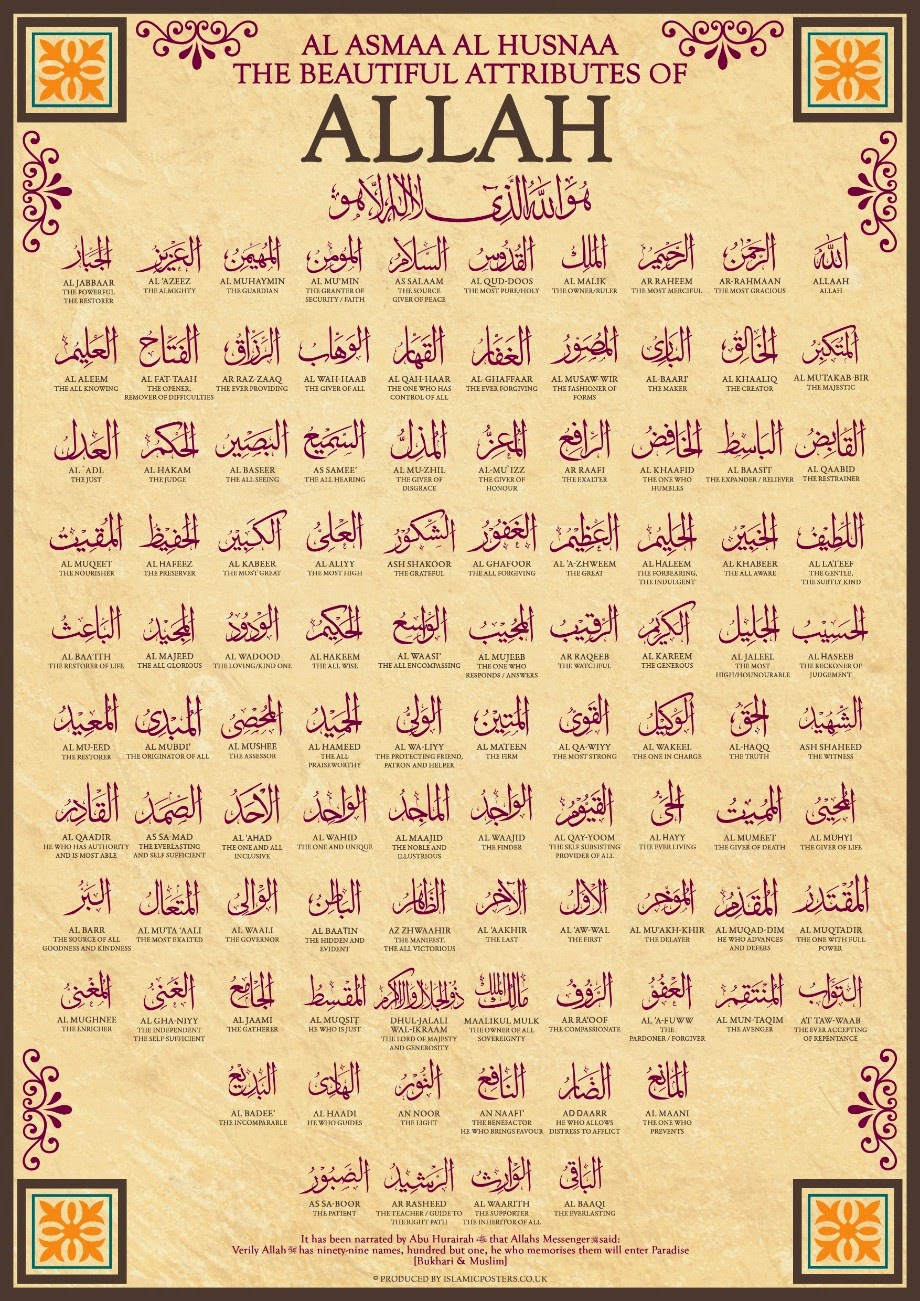
Next, we look into the Attributes of Allah. Regarding the Attributes of Allah, we believe in all Names and Attributes of Him that He imposes upon Himself in the Quran. These are known as the Ninety-Nine Beautiful Names of Divinity (Asma al-Husna). We believe that Allah is described by all that is perfect and exalted beyond all that is imperfect. There is nothing in creation that bears any likeness unto Him. In Atharism this is called Tawhid al-Asma as-Sifaat.
The Attributes of Allah subhana wa ta'ala can be classified into three categories: Personal, Negative and Affirmative. His Personal Attribute is that of Being, that is, He exists. His Negative Attributes are those that negate all characteristics which may tarnish His Absolute Perfection and Divinity. His Affirmative Attributes are those which characterizes Him and all other Attributes of His derive back to these.
In the above paragraph we looked into the basic definitions of the three categories of Allah's Attributes and pinpointed what the first of the three entails. Following this paragraph, we are going to look into the latter two of them: the Negative and the Affirmative. Starting off, let's see the Negatives:
There are five of these,
- Beginninglessness: This negates the perception that God can have a beginning and thus He is limited by time. Allah subhana wa ta'ala created Time and therefore He is not bound by it. His Existence is Eternal.
Rather, Time is bound by Him. - Endlessnessness: This negates the perception that God can have an end.
Allah subhana wa ta'ala shall never cease to exist.
He neither has a beginning nor an end. He is Ever-Living, Infinite. - Oneness: This negates the perception that God is more than one, that is, there exists co-equals to Him in Power and Authority. There is no Might equal to His. He is Almighty, All-Powerful.
- Self-Subsistence: This negates the perception that God is in need of food and rest. God is Self-Sustaining, Independent and free of any need. Rather, all in existence needs Him yet He is beyond the need of all.
- Absolute Uniqueness: This negates the perception that God is like any of His creations or anything in creation is like Him. There is no likeness unto Him in all of existence. Anything that comes to mind of the visage of God is not Him. Our limited mind and senses cannot perceive Him. All His Attributes are uniquely His.
He does not see as we humans see nor hear as we hear. His Greatness is Tremendous, His Wrath is Terrifying and His Mercy is Infinite. This is the core idea of Tawhid al-Asma as-Sifaat. None of His Attributes are like that of any of His servants. He is absolutely dissimilar to all that exists.
Now, let us look at the Affirmative Attributes of Allah subhana wa ta'ala. There are seven of these,
- Life: This is the prerequisite for all the other Attributes. Not all things in existence possess knowledge or will. An entity has to be alive to possess these. Allah subhana wa ta'ala is Living and Ever-Living.
- Knowledge: Allah subhana wa ta'ala has absolute knowledge of all things. This knowledge is not partial nor changing. Allah does not know of a thing or event as it unfolds. Rather, His Knowledge of it is there before it has already happened because Allah is beyond the boundaries of Time. He sees the past, present and future all at once and His Knowledge does not increase nor decrease. His Knowledge is not acquired nor altered. Allah subhana wa ta'ala is All-Wise, Omniscient, Supreme.
- Will: Everything happens by Allah's Will. Whatever He intends to pass shall come to pass. He says "Be" and it is. The Will of Allah is bound by none and encompasses all that exists, has existed or will come to exist.
His Will extends beyond existence and creation. Rather, all that exists in creation exists only by His Will.
Allah subhana wa ta'ala, glorified is He, Exalted and Mighty, King of all Kings. - Power: Allah subhana wa ta'ala is Omnipotent. There is nothing impossible for Him even though the creation may perceive it to be impossible. He can do anything without means or effort. No act is beyond His Grasp.
- Speech: Allah speaks but not as the creature speaks through tongues and language.
Rather, His Speech, like Him, is Eternal. - Sight: Allah sees but not as the creature sees through eyes and light. Rather, His Sight encompasses all, whether they be in the dark or the light, in the depths of the ocean or the heights of the heavens. There is nothing in existence beyond Allah's Sight.
- Hearing: Allah hears but not as the creature hears through ears and sound. Rather, His Hearing is absolute. Not a leaf falls in a garden nor a drop of rain that He does not hear. Allah subhana wa ta'ala hears and answers the call of all who beckon to Him.

These are the Supreme and Divine Attributes of Allah, Unique to Him, and we believe in all of them for disbelief in any of it is tantamount to kufr and renders one beyond the fold of Islam. May Allah subhana wa ta'ala protect us all. Ameen.
Understanding these Attributes is paramount for a believer as it increases one in piety and God-consciousness (taqwa). It is a testament to the Awesome Grandeur of Allah and why He, and Only He, deserves to be worshiped. Atharites call it Tawhid al-Uluhiyyah.
Comprehension of the Divine Oneness of God in Lordship, Visage and Divinity, and frequent Remembrance of it is the Key to increasing Faith because it reminds us then that God exists, His Power is real, His Judgment is Just and He sees, hears and knows all. This reminder steers one away from sin and strengthens their conviction to do good. After all, how can one disobey God and commit sin as he remembers to himself that he is constantly within the Sight, Reach and Knowledge of God?
Moving on to the next tenet of faith, we believe in Allah's angels. We believe that the angels exist and they are true living beings, not metaphors for the forces of nature or anything as such. The angels that have been mentioned about in the Quran and Ahadith are literal and real. We believe that the angels are sinless and entirely incapable of disobeying any of God's Commands regardless of whatever it may be. The angels have the ability to question their Lord but never to go against what He says. Thus they have no free will.

The angels in Heaven are pure, infallible beings, fearsome entities created out of pure, holy light. They spend day and night worshiping God tirelessly without any exhaustion encompassing them. Their existence is a reality and denying it is kufr. May Allah subhana wa ta'ala save us from that. Ameen.

The angels whose names and roles we know about specifically are:


Moving on to the next tenet of faith, we believe in Allah's angels. We believe that the angels exist and they are true living beings, not metaphors for the forces of nature or anything as such. The angels that have been mentioned about in the Quran and Ahadith are literal and real. We believe that the angels are sinless and entirely incapable of disobeying any of God's Commands regardless of whatever it may be. The angels have the ability to question their Lord but never to go against what He says. Thus they have no free will.
The angels in Heaven are pure, infallible beings, fearsome entities created out of pure, holy light. They spend day and night worshiping God tirelessly without any exhaustion encompassing them. Their existence is a reality and denying it is kufr. May Allah subhana wa ta'ala save us from that. Ameen.
Gabriel, also known as Gibril or Jibreel. He is the greatest of all the angels and archangels. He is the Ruh al-Quds, the Holy Spirit. His primary role is to relay Revelation unto the Prophets from their Lord. He was responsible for inspiring Jesus with the Gospel and Muhammad with the Quran. He was also the one to bestow glad tidings of the Birth of Jesus to Mary and the Birth of John to Zechariah. He was one of the two viziers of Muhammad in Heaven, as Abu Bakr and Umar ibn al-Khattab was on Earth, the other being Mikhail. He assisted the Muslim army against the pagans of Mecca during the Battle of Badr.
Michael, also known as Mikael or Mikhail. He is the Sword of Heaven, the one who, at the Command of God, cast out Azazel from the Garden as he lost his Grace and became Iblis, the Accursed. Legend has it that when Mikhail witnessed the creation of Hell, he was so petrified by it, he never smiled again. He was one of the two viziers of Muhammad in Heaven, as Umar ibn al-Khattab and Abu Bakr were on Earth, the other being Jibreel. The duo were also the first ones to obey God's Order to bow down to Adam following his genesis. Michael and his troops assisted the Muslim army against the pagans of Mecca during the Battle of Badr.
Raphael, also known as Israfil, the Archangel of the Trumpet and Herald of the Day of Judgment. When the Hour arrives, by the Command of God, he shall blow into his Horn twice. At the first, all creatures in existence shall die. Then, at the second, all creatures in existence shall be resurrected once again. Thus, the Final Hour shall then begin. May Allah subhana wa ta'ala protect us. Ameen.
Azrael, the Archangel of Death. He sits by a tree whose leaves bear the names of all humans in existence. When a leaf falls, that person's time is up and Azrael reaps their soul. On the Final Day, before the Resurrection, he shall reap the souls of his fellow angels too. Then, all shall be granted life once again.
Our next tenet of faith is belief in the Revealed Books. We believe these books are God's answer to mankind's pleas for Guidance. They are manifestations of Divine Mercy as they are mankind's means of finding true contentment and complete fulfillment in life. We believe such books were revealed to people of every tribe and every nation in their respective languages. Of the books revealed to Man by God, the ones whose names have been specifically mentioned by their names and titles to us within the Noble Quran are — the Scrolls of Abraham (as-Suhuf-e-Ibrahim), the Scrolls of Moses (as-Suhuf-e-Musa), the Torah (at-Tawrat), the Psalms (az-Zabur), the Book of John the Baptist (Kitab-e-Yahya), the Gospel (al-Injeel) and the Quran itself.

Out of these, only the first and the latter two remain, of which only the last one is preserved in its most pristine form in meaning, sound, interpretation and understanding as the unchanged Word of God.
Next, we deal with the fourth tenet of faith in Islam, belief in God's Prophets and Messengers. We believe the Messengers of Allah are infallible and whatever they bring forth as Law is the Truth. There is to be no dispute against them. Whatever they preach is from God, their Message is Absolute.

The Prophets are the ones to whom Allah revealed His Guidance and granted the Wisdom to teach us how to apply it in our daily lives. Hence, the Messengers are our moral and spiritual role models whose ethics and codes of conduct we are to exemplify. Thus we believe these Messengers were exalted beyond all faults and sanctified by Divine Power and Will. They were the very embodiment of their Message.
We believe the Messengers chosen by Allah had four key attributes: they were truthful in words, righteously trustworthy in deeds, intelligent of mind, and loyal to the Cause of God and the task of conveying His Word.
It has been said that Allah has sent over a hundred thousand Messengers to people of every nation, language and tribe, of which the names of twenty-five have been clearly revealed to us. As Muslims, it is obligatory for us to believe that all of them were divinely inspired, free of sin, pure, truthful, noble, trustworthy, wise and firmly upon God's Law. To deny their existence, Message or Prophethood, or to assign unto them characteristics that are unworthy is absolute disbelief (kufr). May Allah subhana wa ta'ala save us from that. Ameen.
The names of these twenty-five Archprophets are: Adam, Idris (Enoch), Nuh (Noah), Hud (Eber), Salih (Saleh), Ibrahim (Abraham), Lut (Lot), Ismail (Ishmael), Ishhaak (Isaac), Yakuub (Jacob), Yusuf (Joseph), Ayyub (Job), Shuayb (Jethro), Musa (Moses), Harun (Aaron), Dhul-kifl (Ezekiel), Da'wuud (King David), Sulayman (King Solomon), Ilyas (Elijah), al-Yasa (Elisha), Yunus (Jonah), Zakariyya (Zechariah), Yahya (John the Baptist), Isa (Jesus) and Muhammad, peace and blessings of God be upon them all.

Other figures mentioned in the Quran and other Islamic literature who display prophetic qualities or have been disputed to be prophets by scholars but have not been explicitly mentioned as prophets are: Uzair (Ezra), Samuel, Kalib (Caleb), Khidhr (Melchizedek), Raubil (Reuben), Shimon (Simeon), Lewi (Levi), Yahud (Judah), Daan (Dan), Naftali (Naphtali), Gaad (Gad), Asher, Yissakar (Issachar), Dhibulun (Zebulun), ibn-Yameen (Benjamin), Luqman, Maryam (Mary), Dhul-Quarnain, Isaiah (Ishiya), Daniyal (Daniel), Irmiyah (Jeremiah), Yeshua ibn Nuun (Joshua), Zakariyya ibn Barakiah (Zachariah, the son of Berekiah), Zakariyya ibn Yahadiya (Zachariah, the son of Jehoiada), Shith (Seth), Shem (Sam), and Habil (Abel), peace be upon them all.
Regarding most of the aforementioned characters, a clear case can be made of their prophethood. However, for obvious reasons, such cannot be said of the sons of Jacob from Reuben to Zebulun due to their actions against Hazrat Yusuf. Therefore, the larger and most weightier consensus among the scholars is that they are not prophets. May God protect us from all misgivings. Ameen.
These are the figures whose lives, stories and teachings hold paramount value to us, whose examples we are asked to emulate in our daily lives to become a force for good in this world, repel evil and please Allah subhana wa ta'ala.
Prophet Muhammad, peace be upon him, is the Seal of all the Messengers and the Imam of all the Prophets.
He is the Mercy upon all of Mankind and as such we have seven obligations that we are to fulfill towards him.


So, we are always to make frequent remembrance of Death, remember that soon we are to die and then we are to be judged for all our deeds, good or bad. We are to be taken account of and rewarded or punished depending on our level of Faith and adherence to the Law. Frequent remembrance of this is the route to avert from sin. Whenever you are tempted to sin, remind yourself this that that very act could be your very last. Remember. Remember and avoid the sin. Have hope, instead, for the Grand Reward and Eternal Bliss. This should be attitude of the believer.

The believer is to remind themselves that Death is true, the Resurrection is real and the Judgment of God is always near. The Day is fast approaching that all shall be taken to account. The Day is fast approaching that the Scales shall be brought forth and the deeds measured. The Bridge to Heaven across the Great Jaws of Hell is to be laid and the Final Crossing shall then begin. Those sound in Faith and frequent in righteous deeds shall cross the bridge in the blink of an eye while those drowning in Sin shall be burdened by the great weight of their wickedness and fall into the fiery pits of Perdition, eternally damned, condemned for their misdeeds and made to perish in everlasting agony; and the righteous shall then replenish themselves by the Fount at the Gates of Heaven. The Dew of the Sealed Nectar shall be delivered unto them by their Lord. Then they shall taste everlasting joy and pleasure. Their eyes shall be Graced by the Glorious Visage of God. Eternal Bliss awaits them.

These are the realities of Death and the Afterlife that is asked of every Muslim to believe and they are not metaphors nor allegories but rather the truth and all of it shall surely come to pass.

The last of the six Islamic tenets of faith is belief in Qadr, that is, Predestination. Regarding Qadr, it is to believe that both good and bad come from Allah. The consequences of all our choices are decreed by Allah. However, it is kufr to believe that we have no choice, as believed the Jabariyyah, because Allah has made known to us that we, and the Jinn, possess free-will. Yet, at the same time it is also kufr to believe that our actions are all independent of Allah's Will and Power, as believed the Qadariyyah. Rather, we are advised to take the middle path and believe we have free-will but our actions take place by the Will of Allah.
This is by far the most complicated of matters to understand. The best way to elucidate this is by the means of an example. Let us assume that Gary wanted to punch Ash in the face. Here, Gary is intending to punch Ash in the face and making the decision to go through with his intentions by his own free-will. Allah, knowing of Gary's intentions, creates the action of Gary punching Ash in the face by His Power and Will. Thus He allows and formulates the action that Gary intended to perform by Gary's freedom of choice. Therefore, Gary is the one accountable for it, not God. This is the belief in relation to Qadr of the Ahlus Sunnah w'al Jama'ah.
— Fahim Ferdous Kibria
Out of these, only the first and the latter two remain, of which only the last one is preserved in its most pristine form in meaning, sound, interpretation and understanding as the unchanged Word of God.
Next, we deal with the fourth tenet of faith in Islam, belief in God's Prophets and Messengers. We believe the Messengers of Allah are infallible and whatever they bring forth as Law is the Truth. There is to be no dispute against them. Whatever they preach is from God, their Message is Absolute.
The Prophets are the ones to whom Allah revealed His Guidance and granted the Wisdom to teach us how to apply it in our daily lives. Hence, the Messengers are our moral and spiritual role models whose ethics and codes of conduct we are to exemplify. Thus we believe these Messengers were exalted beyond all faults and sanctified by Divine Power and Will. They were the very embodiment of their Message.
We believe the Messengers chosen by Allah had four key attributes: they were truthful in words, righteously trustworthy in deeds, intelligent of mind, and loyal to the Cause of God and the task of conveying His Word.
It has been said that Allah has sent over a hundred thousand Messengers to people of every nation, language and tribe, of which the names of twenty-five have been clearly revealed to us. As Muslims, it is obligatory for us to believe that all of them were divinely inspired, free of sin, pure, truthful, noble, trustworthy, wise and firmly upon God's Law. To deny their existence, Message or Prophethood, or to assign unto them characteristics that are unworthy is absolute disbelief (kufr). May Allah subhana wa ta'ala save us from that. Ameen.
The names of these twenty-five Archprophets are: Adam, Idris (Enoch), Nuh (Noah), Hud (Eber), Salih (Saleh), Ibrahim (Abraham), Lut (Lot), Ismail (Ishmael), Ishhaak (Isaac), Yakuub (Jacob), Yusuf (Joseph), Ayyub (Job), Shuayb (Jethro), Musa (Moses), Harun (Aaron), Dhul-kifl (Ezekiel), Da'wuud (King David), Sulayman (King Solomon), Ilyas (Elijah), al-Yasa (Elisha), Yunus (Jonah), Zakariyya (Zechariah), Yahya (John the Baptist), Isa (Jesus) and Muhammad, peace and blessings of God be upon them all.
Other figures mentioned in the Quran and other Islamic literature who display prophetic qualities or have been disputed to be prophets by scholars but have not been explicitly mentioned as prophets are: Uzair (Ezra), Samuel, Kalib (Caleb), Khidhr (Melchizedek), Raubil (Reuben), Shimon (Simeon), Lewi (Levi), Yahud (Judah), Daan (Dan), Naftali (Naphtali), Gaad (Gad), Asher, Yissakar (Issachar), Dhibulun (Zebulun), ibn-Yameen (Benjamin), Luqman, Maryam (Mary), Dhul-Quarnain, Isaiah (Ishiya), Daniyal (Daniel), Irmiyah (Jeremiah), Yeshua ibn Nuun (Joshua), Zakariyya ibn Barakiah (Zachariah, the son of Berekiah), Zakariyya ibn Yahadiya (Zachariah, the son of Jehoiada), Shith (Seth), Shem (Sam), and Habil (Abel), peace be upon them all.
Regarding most of the aforementioned characters, a clear case can be made of their prophethood. However, for obvious reasons, such cannot be said of the sons of Jacob from Reuben to Zebulun due to their actions against Hazrat Yusuf. Therefore, the larger and most weightier consensus among the scholars is that they are not prophets. May God protect us from all misgivings. Ameen.
These are the figures whose lives, stories and teachings hold paramount value to us, whose examples we are asked to emulate in our daily lives to become a force for good in this world, repel evil and please Allah subhana wa ta'ala.
Prophet Muhammad, peace be upon him, is the Seal of all the Messengers and the Imam of all the Prophets.
He is the Mercy upon all of Mankind and as such we have seven obligations that we are to fulfill towards him.
These seven rights we owe the Prophet, sallallahu wa alayhi wa salam, are,
- Believe in him,
- Love him,
- Venerate him,
- Be grateful to him,
- Send blessings upon him,
- Follow him, and,
- Strive to instill his characteristics upon our hearts, formally and spiritually.
Now, in order to fulfill these aforementioned rights it is important for us to know the Prophet. Because it is nigh-impossible to love or follow someone without knowing them. Therefore, it is asked of us to seek and know the Prophet Muhammad through the aid of studying the Seerah and Shamaa'il.
Since, all the Prophets were physical manifestations of their Message and the Quran is the summation of all the previously revealed Messages, Prophet Muhammad can thus be said to be the Living Quran and, subsequently the Living Torah, Psalms and Gospel. His Characteristics and Mannerisms are those of every other Prophet before him. He is the Key to Perfection.
Moving on to the fifth tenet of faith, we have belief in the reality of Death and the Afterlife. As a Muslim, it is of grave importance to believe that Death is true and the Final Judgment is surely to come. The Prophet, peace be upon him, is narrated to have said,
"Make oft-remembrance of Death — the Destroyer of all Pleasures."
So, we are always to make frequent remembrance of Death, remember that soon we are to die and then we are to be judged for all our deeds, good or bad. We are to be taken account of and rewarded or punished depending on our level of Faith and adherence to the Law. Frequent remembrance of this is the route to avert from sin. Whenever you are tempted to sin, remind yourself this that that very act could be your very last. Remember. Remember and avoid the sin. Have hope, instead, for the Grand Reward and Eternal Bliss. This should be attitude of the believer.
The believer is to remind themselves that Death is true, the Resurrection is real and the Judgment of God is always near. The Day is fast approaching that all shall be taken to account. The Day is fast approaching that the Scales shall be brought forth and the deeds measured. The Bridge to Heaven across the Great Jaws of Hell is to be laid and the Final Crossing shall then begin. Those sound in Faith and frequent in righteous deeds shall cross the bridge in the blink of an eye while those drowning in Sin shall be burdened by the great weight of their wickedness and fall into the fiery pits of Perdition, eternally damned, condemned for their misdeeds and made to perish in everlasting agony; and the righteous shall then replenish themselves by the Fount at the Gates of Heaven. The Dew of the Sealed Nectar shall be delivered unto them by their Lord. Then they shall taste everlasting joy and pleasure. Their eyes shall be Graced by the Glorious Visage of God. Eternal Bliss awaits them.
These are the realities of Death and the Afterlife that is asked of every Muslim to believe and they are not metaphors nor allegories but rather the truth and all of it shall surely come to pass.
The last of the six Islamic tenets of faith is belief in Qadr, that is, Predestination. Regarding Qadr, it is to believe that both good and bad come from Allah. The consequences of all our choices are decreed by Allah. However, it is kufr to believe that we have no choice, as believed the Jabariyyah, because Allah has made known to us that we, and the Jinn, possess free-will. Yet, at the same time it is also kufr to believe that our actions are all independent of Allah's Will and Power, as believed the Qadariyyah. Rather, we are advised to take the middle path and believe we have free-will but our actions take place by the Will of Allah.
This is by far the most complicated of matters to understand. The best way to elucidate this is by the means of an example. Let us assume that Gary wanted to punch Ash in the face. Here, Gary is intending to punch Ash in the face and making the decision to go through with his intentions by his own free-will. Allah, knowing of Gary's intentions, creates the action of Gary punching Ash in the face by His Power and Will. Thus He allows and formulates the action that Gary intended to perform by Gary's freedom of choice. Therefore, Gary is the one accountable for it, not God. This is the belief in relation to Qadr of the Ahlus Sunnah w'al Jama'ah.
— Fahim Ferdous Kibria
Monday, July 7, 2014
Saturday, July 5, 2014

Friday, July 4, 2014
Thursday, July 3, 2014
Essentials of Islam — Knowledge and Guidance

Assalam Walaikum.
The following are my transcribed notes from the Seeker's Guidance course "Absolute Essentials Of Islam" conducted by Sheikh Faraz Rabbani, Ustadh Abdullah Misri and Ustadha Shireen Ahmed. The course is based on the textbook of the same name by Sheikh Faraz Rabbani which is a short manual on matters of Faith and Practice according to the Sunni Hanafi School of Islamic Law and Jurisprudence. A bulk of the course focuses on matters related to Purification and Prayer while briefly touching upon the fundamentals of Zakat and Fasting.
For the introduction we will be focusing on the Way of Guidance to understanding the Quran and Sunnah, and exploring the three dimensions of our religion: Imaan (Faith), Islam (Submission) and Ihsan (Excellence). In this article I will, insha'Allah, be answering the following questions:
- What is the importance of Knowledge? What is the proper manner (adab) of attaining it?
- What is the Spirit? What is its purpose? How do we succeed in achieving it?
- What is the Islamic definition of Guidance? Why is it important? How must we acquire it?
- What is the Hadith of Gabriel and what is its importance in elucidating to us our creed?
"Whoever Allah wishes well for, He grants them the knowledge of religion."
[Sahih al-Bukhari, Book 3, Hadith no. 71]
Knowledge of religion is important because it helps in fulfilling the purpose of our life. And, insha'Allah, we will soon be touching upon that topic in details but to sum it shortly, the purpose of our life is to please Allah subhana wa ta'ala and attaining His Pleasure in this life for the eternal reward in the afterlife. We do this through the means of worship, and knowledge allows us to perfect our worship of Him by making it sound, proper and valid. The central mission of this course is to provide us with that knowledge.

Knowledge is important in practice because knowing leads us to acting and acting leads us to sincerity. By knowing of the myriad methods of worshiping Allah and striving for His Pleasure we are more prone to acting upon them and with greater sincerity. This is the benefit of Knowledge. But how must we attain it? What are the basic principles to follow for the Seeker of Knowledge?
The adab of attaining knowledge entails three actions: the Seeker of Knowledge must come to the table prepared to learn what he seeks, be attentive in absorbing it and diligent in reviewing it. Sounds basic enough, right? Well, it is. Preparation beforehand is important because imagine showing up to a mathematics class expecting it's elementary Italian. You aren't prepared to do all those number crunching equations, you are there to learn how to order pizza in its native tongue. You didn't sign up for this. What to do now? You are unprepared. So yes, that's your first principle.
The second and third are also pretty academic and does not need much explaining. You cannot really learn anything if the teacher is explaining the fiqh of fasting while you are jelly-fishing inside your head. And to solidify what you have learned in class, it is obvious that you must review it. Remember, everyone has photographic memory but most people are out of film.
Now that we have touched upon the adab of learning and acquiring knowledge, it is time to move into the key details of our course material. We begin by learning about the Ruh, that is, the Spirit. What is the Spirit? What is this Ruh? The Ruh is one of the three components that makes the human being truly a human being. The other two are the Qalb (the Heart) and the Nafs (the Soul). The Ruh is the delicate subtlety within ourselves by which we exist. And what does this Ruh yearn for? What is its true calling? The Ruh's true calling is its Reunion with the Lord.

The Ruh, that is, the Spirit, was created in Heaven and made to submit before its Lord. This is the natural state (Fitrah) of its existence. That is, the Spirit is inclined by default to be in submission before our Lord. Such is the Divine Plan of God. Therefore, every time we perform an action that causes us to turn away from the Lord, that causes us to disobey God, our Spirit is cast into a state of unrest. The Spirit craves to submit and reunite with God. And this is the Purpose of Life. The purpose of our lives is the calling that our Spirits crave for. Until then, the Spirit, and subsequently the Heart, cannot find rest. That is why Allah tells us in the Quran,
Knowledge is important in practice because knowing leads us to acting and acting leads us to sincerity. By knowing of the myriad methods of worshiping Allah and striving for His Pleasure we are more prone to acting upon them and with greater sincerity. This is the benefit of Knowledge. But how must we attain it? What are the basic principles to follow for the Seeker of Knowledge?
The adab of attaining knowledge entails three actions: the Seeker of Knowledge must come to the table prepared to learn what he seeks, be attentive in absorbing it and diligent in reviewing it. Sounds basic enough, right? Well, it is. Preparation beforehand is important because imagine showing up to a mathematics class expecting it's elementary Italian. You aren't prepared to do all those number crunching equations, you are there to learn how to order pizza in its native tongue. You didn't sign up for this. What to do now? You are unprepared. So yes, that's your first principle.
The second and third are also pretty academic and does not need much explaining. You cannot really learn anything if the teacher is explaining the fiqh of fasting while you are jelly-fishing inside your head. And to solidify what you have learned in class, it is obvious that you must review it. Remember, everyone has photographic memory but most people are out of film.
Now that we have touched upon the adab of learning and acquiring knowledge, it is time to move into the key details of our course material. We begin by learning about the Ruh, that is, the Spirit. What is the Spirit? What is this Ruh? The Ruh is one of the three components that makes the human being truly a human being. The other two are the Qalb (the Heart) and the Nafs (the Soul). The Ruh is the delicate subtlety within ourselves by which we exist. And what does this Ruh yearn for? What is its true calling? The Ruh's true calling is its Reunion with the Lord.
The Ruh, that is, the Spirit, was created in Heaven and made to submit before its Lord. This is the natural state (Fitrah) of its existence. That is, the Spirit is inclined by default to be in submission before our Lord. Such is the Divine Plan of God. Therefore, every time we perform an action that causes us to turn away from the Lord, that causes us to disobey God, our Spirit is cast into a state of unrest. The Spirit craves to submit and reunite with God. And this is the Purpose of Life. The purpose of our lives is the calling that our Spirits crave for. Until then, the Spirit, and subsequently the Heart, cannot find rest. That is why Allah tells us in the Quran,
"Verily, in the Remembrance of Allah do Hearts find rest." (13:28)
And this Remembrance is our Guidance. This Remembrance is the Way back to our Lord, the Path to our Salvation, and that is why in reciting this Remembrance do our Hearts and our Spirits and our Souls find peace, rest and tranquility. This Remembrance is the Quran.

The parable of our existence in this world and our journey to the next is like that of a group of people waking up inside a train. Some of the people wake up within the train without any knowledge of how they got there and where it is heading. However, regardless of their lack of understanding, they do not seek to know. They are complacent with being there and resigned to their fate, whatever it may be. Then there is a group of people who are inside the train and they get too attached to the various luxuries presented to them within the train. They have no intention of getting off even though at some point they must. Finally, there is a group of people who enjoy the luxuries presented to them within the train but they are also prepared to leave when the time comes. They only eat and drink and savor the joys of being in the train as much as needed to sustain them until they arrive at their destination. This third group of people display the attitude of the believer.
The Prophet Muhammad, peace be upon him, has said, "An intelligent person is one who takes themselves into account." This third party of people mentioned are those who take themselves to account. They are aware of their standing and actively preparing themselves for the destination that is to come. Some of them long for it. But how do we, ourselves, prepare for it? How can we be of those among the third group of people? Where is our instruction manual? We have to understand that our Spirit is craving for this fast approaching Destination and it is desperately yearning to get ready. That is why in reading and preparing for the End to our Journey do our Spirit and Heart find peace and rest. And the Guidance to do that, the instruction manual, is none but the Holy Quran.
Allah subhana wa ta'ala has revealed within the Quran the answer to our Spirit's eternal craving. And this answer is,
The parable of our existence in this world and our journey to the next is like that of a group of people waking up inside a train. Some of the people wake up within the train without any knowledge of how they got there and where it is heading. However, regardless of their lack of understanding, they do not seek to know. They are complacent with being there and resigned to their fate, whatever it may be. Then there is a group of people who are inside the train and they get too attached to the various luxuries presented to them within the train. They have no intention of getting off even though at some point they must. Finally, there is a group of people who enjoy the luxuries presented to them within the train but they are also prepared to leave when the time comes. They only eat and drink and savor the joys of being in the train as much as needed to sustain them until they arrive at their destination. This third group of people display the attitude of the believer.
The Prophet Muhammad, peace be upon him, has said, "An intelligent person is one who takes themselves into account." This third party of people mentioned are those who take themselves to account. They are aware of their standing and actively preparing themselves for the destination that is to come. Some of them long for it. But how do we, ourselves, prepare for it? How can we be of those among the third group of people? Where is our instruction manual? We have to understand that our Spirit is craving for this fast approaching Destination and it is desperately yearning to get ready. That is why in reading and preparing for the End to our Journey do our Spirit and Heart find peace and rest. And the Guidance to do that, the instruction manual, is none but the Holy Quran.
Allah subhana wa ta'ala has revealed within the Quran the answer to our Spirit's eternal craving. And this answer is,
"Ihdinas Sirat al-Mustaqim" (1:6)
That is, the plea,
"Guide us to the Straight Path of the Righteous."
This Verse, this Prayer, is the Key to our Salvation. It is the answer, God's Answer, to the innate craving of our Spirit,
"O restless Spirit of Man, say: Guide us to the Straight Path, and I shall guide you to Me!"

This is the Purpose of Life. It is the Journey on the Straight Path of the Righteous towards the Eternal Reunion with God. The purpose of our life is nothing more than to perfect our relationship with Allah subhana wa ta'ala by following His Guidance embedded within the Quran. And how do we know that the Guidance laid down to us in the Holy Quran is the Truth? We know it because of the Divine Promise from the Lord, our God:
"Inna nahnu nazzalna al-dhikr wa inna lahu lahafidun" (15:9)Which, translated in meaning and interpretation into the English language, reads as,
"Verily, it is We Who has revealed to you this Remembrance and it is We Who shall preserve it."The word "dhikr" i.e. "Remembrance" here is of importance because it means that Allah subhana wa ta'ala has not only promised to preserve the words of the Quran but He shall also preserve its understanding and wisdom. This is the purpose of Prophethood, that is, they have been sent to convey the Message of Allah to all of humanity and teach us the wisdom to apply it in our daily lives. In the aforementioned Verse of the Quran, Allah subhana wa ta'ala assures us that the Quran is indeed Godsent and Preserved. It is our Guide to Eternal Bliss and Salvation.

Allah subhana wa ta'ala has stated that whoever He wishes well for, He grants them the Knowledge of Religion and this Sacred Knowledge has been directly transmitted to us through the Prophets to the Scholars as it has been said,
"The Scholars are the inheritors of the Prophets."
It has also been narrated that the Prophet Muhammad, peace be upon him, said,
"My community shall never unite upon falsehood."
And,
"There shall always remain a group among my community manifest on the Truth."
These narrations are important because it tells us how to seek out the proper interpretation of the Remembrance and Guidance that Allah has laid down for us through the Prophets. From the above narrations we conclude that the way to find out the most precise understanding of Allah's Guidance and Remembrance is to follow the mainstream Scholars who are the inheritors of the Prophets. They are the united majority group manifest on the Truth, the Ulema of the Ahlus Sunnah w'al-Jama'ah. And the litmus test to gauge the accuracy of the interpretation of God's Remembrance and Guidance is to calibrate its closeness to Mercy for the Essence of Guidance is Mercy as said by Sheikh Abdul Hakim Murad, "Every teaching of Islam is a manifestation of Divine Mercy, and any practice of Islam lacking in mercy is devoid of proper understanding."

Thus far we have covered the importance of seeking knowledge, the etiquette of seeking knowledge and the transmission of knowledge itself in the creed of Islam. We discussed how the gift of knowledge has been relayed from Allah to His Prophets and the Prophets to the Scholars. Now we will be discussing the Hadith of Gabriel and the three dimensions of belief in our religion: Imaan, Islam and Ihsan.
What is the Hadith of Gabriel? The Hadith of the Archangel Gabriel is a narration related to us by Imam Bukhari and Imam Muslim on the authority of Hazrat Abu Hurairah, may Allah be pleased with him. It can be found in the first volume of Sahih al-Bukhari, Book 2, Hadith no. 48, and Sahih al-Muslim, Book 1, Hadith no. 4.
The narration from Sahih Bukhari goes,


We start by understanding what is Imaan. Imaan is to confirm the Existence and Divine Oneness of God — Allah subhana wa ta'ala — rejecting all equals to Him and His Power, affirming no Supreme Authority exists but He. Next, we tackle with the understanding of Islam, that is, Submission.
After confirming His Existence and Oneness, affirming that He exists and He is the Only One so to Him, the Almighty God of Abraham, belongs Sovereignty of the Heavens and the Earth, our next order of business is to submit to His Will acknowledging He is All-Wise, All-Powerful and there is no Power in existence but He. This act of submission is Islam and the one who performs it is a Muslim.
Finally, we have Ihsan, which is, Excellence in Worship, that is, to worship Allah subhana wa ta'ala as if one sees Him and keeping in mind that He sees us. This reminds me of a dear friend's mantra he invoked before every prayer, "Pray to Allah as if you see Him, for verily He sees you."
— Fahim Ferdous Kibria
What is the Hadith of Gabriel? The Hadith of the Archangel Gabriel is a narration related to us by Imam Bukhari and Imam Muslim on the authority of Hazrat Abu Hurairah, may Allah be pleased with him. It can be found in the first volume of Sahih al-Bukhari, Book 2, Hadith no. 48, and Sahih al-Muslim, Book 1, Hadith no. 4.
The narration from Sahih Bukhari goes,
One day while the Prophet was sitting in the company of some people, the Archangel Gabriel came and asked, "What is Imaan (Faith)?"
Allah's Apostle replied, "Faith is to believe in Allah, His angels, the Meeting with Him, His Apostles, and to believe in Resurrection."
Then he further asked, "What is Islam (Submission)?"
Allah's Apostle replied, "To worship Allah Alone and no-one else, to offer prayers perfectly, to pay the compulsory charity (Zakat) and to observe fasts during the month of Ramadan."
Then he further asked, "What is Ihsan (Excellence)?"
Allah's Apostle replied, "To worship Allah as if you see Him, and if you cannot achieve this state of devotion then you must consider that He is looking at you."
Then he further asked, "When will the Hour be established?"
Allah's Apostle replied, "The one who answers has no better knowledge than the one who questions. However, I will inform you of its portents — When a slave lady gives birth to her master, and when the shepherds of black camels start boasting and competing with others in the construction of tall buildings. And the Hour is one of five things which nobody knows except Allah."
The Prophet then recited, "Verily, with Allah Alone is the knowledge of the Hour."
Following this Gabriel left and the Prophet asked his companions to call him back, but they could not see him. The Prophet then said, "That was the Archangel Gabriel who came to teach the people their religion." Abu 'Abdullah said, "He considered all that as tenets of Faith."
The narration from Sahih Muslim goes,
One day the Messenger of Allah, may peace be upon him, appeared before the public and a man came to him and asked, "Prophet of Allah, what is Imaan (Faith)?The Hadith is pretty self-explanatory and does not require much elaboration. It is the single most important narration in Sunni theology forming the core six articles of Islamic belief and the five pillars of faith.
Upon this the Prophet replied, "That you affirm you believe in Allah, His angels, His Books, the meeting with Him, His Messengers and that you affirm you believe in the Resurrection hereafter.
He then asked, "Messenger of Allah, what does Islam (Submission) entail?
The Prophet replied, "Islam signifies that you worship Allah Alone and do not associate anything with Him and you establish obligatory prayer and you pay the obligatory charity (Zakat) and you observe the fast of Ramadan.
He then asked, "Messenger of Allah, what does Ihsan (Excellence) imply?"
The Prophet replied, "That you worship Allah as if you are seeing Him, and in case you fail to see Him, then observe prayer with this idea in your mind that at least He is seeing you.
He then asked, "Messenger of Allah, when would there be the establishment of the Hour of Doom?
The Prophet replied, "The one who is asked about it is no better informed than the one who asks. I, however, can narrate some of its Signs — when the slave girl will give birth to her master, and when the naked and barefooted would become the chiefs of the people — these are some of the Signs of the Doomsday. Moreover, when the shepherds of the black camels would exult themselves in buildings, this is one of the Signs of the Doomsday. The Doomsday is one of the five happenings wrapped in the Unseen of which no-one knows about but Allah Alone.
Then the Messenger of Allah recited the Verse:" Verily Allah! with Him Alone is the Knowledge of the Hour and He it is Who sends down the rain and knows that which is in the wombs and no-one knows whatsoever he shall earn tomorrow, and a person knows not in whatsoever land he shall die. Verily Allah is All-Aware, Omniscient."
At this the person turned back and went away. The Messenger of Allah, may peace be upon him, said, "Bring that man back to me." The Disciples went to bring him back, but they saw nothing there. Upon this the Messenger of Allah remarked, "He was the Archangel Gabriel, who came to teach the people their religion."
We start by understanding what is Imaan. Imaan is to confirm the Existence and Divine Oneness of God — Allah subhana wa ta'ala — rejecting all equals to Him and His Power, affirming no Supreme Authority exists but He. Next, we tackle with the understanding of Islam, that is, Submission.
After confirming His Existence and Oneness, affirming that He exists and He is the Only One so to Him, the Almighty God of Abraham, belongs Sovereignty of the Heavens and the Earth, our next order of business is to submit to His Will acknowledging He is All-Wise, All-Powerful and there is no Power in existence but He. This act of submission is Islam and the one who performs it is a Muslim.
Finally, we have Ihsan, which is, Excellence in Worship, that is, to worship Allah subhana wa ta'ala as if one sees Him and keeping in mind that He sees us. This reminds me of a dear friend's mantra he invoked before every prayer, "Pray to Allah as if you see Him, for verily He sees you."
— Fahim Ferdous Kibria
Tuesday, July 1, 2014




Subscribe to:
Posts (Atom)