Showing posts with label Metaphysics. Show all posts
Showing posts with label Metaphysics. Show all posts
Sunday, November 30, 2014

Friday, November 14, 2014
Unity of Existence

Shaykh al-Akbar Imam ibn Arabi al-Hatimi at-Tai termed this concept "the Unity of Existence" — al-Wahdat al-Wujud.


A common argument against the concept of al-Wahdat al-Wajud, often brought up by the Wahhabi Muslims such as the likes of Dr. Zakir Naik and Dr. Bilal Philips, is that it is Shirk in the form of Pantheism: untrue.

Pantheism is the belief that God is present in creation in the physical sense which is, thus, worshiped. This leads to paganism and idolatry as the objects in creation are directly worshiped as God, reducing Them to being bound in three-dimensional entities existing within spacetime.

In sharp contrast, Wahdatul-Wujud enhances God beyond any space, time or dimensional boundaries by stating that if everything in being was extended to infinity, nothing would remain but God. That is, a two-dimensional picture of
a house can be rendered into three-dimensional form, converting the image into an actual house with height, weight, width and length. However, if everything in existence was, similarly, rendered into infinite dimensions, then it would all cease to exist except for God. Therefore, in the greater scheme of things, we conclude, nothing exists but God.
a house can be rendered into three-dimensional form, converting the image into an actual house with height, weight, width and length. However, if everything in existence was, similarly, rendered into infinite dimensions, then it would all cease to exist except for God. Therefore, in the greater scheme of things, we conclude, nothing exists but God.


This is the Ultimate Truth. This is the Unity of Creation and All of Existence. This is Wahdat al-Wujud.

Thursday, November 13, 2014
Moral Philosophy and the Metaphysics of Ethics

Moral Philosophy
Aim: to establish the
supreme principle of morality
Preface
Kant begins by systematizing knowledge (Kant is very fond of
systematizing).
He makes the observation that Ancient Greek thinkers divided
philosophy into three sciences:
- Physics
- Ethics
- Logic
Kant agrees with
this division but seeks to explain the reasoning behind this division by
introducing new division.
- Formal: concerned solely with the form of the
understanding and form of reason itself;
universal rules of thinking as such: this is logic - Universal and necessary laws of thinking
- Can have no empirical (based on experience) component
- So is “pure philosophy” – based on a priori principles
- Material: concerned with specific objects and their laws (as opposed to the forms of the understanding and reason); consists of two parts
- Laws of nature: physics/natural philosophy
- Laws according to which everything happens
- Laws of freedom/moral philosophy
- Laws according to which everything ought to happen
- Does his description of ethics strike anyone as odd (laws of freedom)?
- The point: we see the importance of freedom and laws in ethics.
- Ethics differs from physics in that its laws, laws of freedom, are not descriptive but instead prescriptive.
- Both have an empirical component
- Empirical component of ethics is practical anthropology
- “Moral philosophy has to define the laws of the human will, to the extent that the will is affected by nature.”
- However, ethics can also be pure (based on a priori principles).
- When pure philosophy is limited to specific objects, it is called metaphysics. (Thus the name metaphysics of morals)
- Metaphysics of morals, and only the metaphysics, is moral philosophy.
- This part is also called the rational part.
Metaphysics must precede the empirical part and must “be scrupulously cleansed of everything empirical” to know “how much pure reason can accomplish”
- He later states that anything which mixes pure and empirical principles “does not even deserve to be called philosophy…still less…moral philosophy”
- Practical judgment, sharpened by experience, is needed to discern the cases to which the moral law applies. However, the laws themselves do not draw upon experience.
Why? Moral law, to be law, must carry absolute necessity to be morally valid – “valid, that is, as a basis of obligation.” It must also not hold only for humans but for any rational being. So, the law cannot be grounded in human nature or facts about us or our world, for these things which are contingent. Nothing empirical but pure reason only can be used in determining moral law
This “pure” moral philosophy is concerned with a “pure will” and not human volition generally.
The pure is not concerned with humans tend to do or what we often do but instead with what a rational will, free from inclinations (likes, dislikes, wants, desires, aversions, etc) can do. This will is motivated only by a priori principles.
It acts out of duty in accordance with the Moral Law; its actions are done for the sake of the moral law instead of merely conforming to it.
This “pure” moral philosophy is concerned with a “pure will” and not human volition generally.
The pure is not concerned with humans tend to do or what we often do but instead with what a rational will, free from inclinations (likes, dislikes, wants, desires, aversions, etc) can do. This will is motivated only by a priori principles.
It acts out of duty in accordance with the Moral Law; its actions are done for the sake of the moral law instead of merely conforming to it.
- There is a difference between done for sake of and conforming. If the actions is not done out of duty, then the coincidence of the action with the moral merely happens chance; it is a coincidence.
- Actions for the sake of duty are the only actions that are morally good.
Ch. 1: Passage from
the Common Rational Knowledge of Morality to the Philosophical
Good Will
Will: the ability to determine action according to
principles.
- We have a will. My cat does not.
- Constitutes an indispensable condition of our worthiness to be happy.
- It is the only thing with “intrinsic moral worth.”
- It is the only thing with intrinsic worth because a good will is the only thing that always has morally good ends.
- Though helpful, gifts of nature and of fortune do not; Villains can have wit, intelligence, and bravery.
- This is why it is the only thing good without qualification
- It has “intrinsic moral worth” because it “has full worth in itself” regardless of consequences.
- A good will is good even if it achieves nothing; utility adds nothing to its worth.
Since the notion that utility doesn’t matter to value at all is a bit strange, Kant presents
an argument against utilitarianism (or at least a version of it).
- P1: “no instrument for any purpose will be found in that being unless it is also the most appropriate and best adapted for that purpose.”
- P2: reason is an instrument nature gave to us
- P3: Assume nature’s purpose for beings with reason and wills are their own individual preservation, welfare, or happiness.
- P4: Reason is not the most appropriate tool for preservation, welfare, or happiness.
- Support: Instinct would be a better way of meeting these ends.
- Support: Reason is a poorly suited to achieve these ends.
- Casts reason in rather negative light here
- Reason provides “feeble and defective guidance”
- “Nature would have prevented reason from…presuming, with its feeble insights, to think out for itself a plan for happiness and for the means of attaining it.”
- Furthermore, those who devote their cultivated reason to the enjoyment of life and happiness end up far away from content.
C: So…Reason is an instrument not for happiness but for some “worthier” end; and rejection of P3.
Points to push back on:
Points to push back on:
- P1
- P4 – specifically if the focus of utilitarianism is not just on one’s own happiness but maximizing happiness.
{as a side note, Mill wasn’t born until 2 years after Kant died}
- Not the sole good, but the highest good and the condition on all the rest (goods of fortune and of nature)
- The will has its own kind of satisfaction – not happiness but “satisfaction from fulfilling a purpose which reason alone determines”
- Acting out of duty in accordance with the Moral Law (Note: moral law, not laws).
The Three Propositions
Regarding Moral Duty
Proposition 1: To have genuine moral merit an action must be
done from, not just according to, duty.
- The action cannot be opposed to duty
- The action must have a direct inclination, meaning that the actions is not done because the agent is compelled by another inclination
- Ex: hypnosis; involuntary spasms; being nice to look good in front of your boss; Kant’s example of a shopkeeper giving correct change.
- This also means that the action cannot be done out of self-interest
- Difficulty arises when direct inclination and something else is at play. For something to be done out of duty, Kant implies that it must be done solely out of duty, out a direct inclination. So some actions can be in conformity with duty but not out of duty [so, acting out of sympathy, happiness, self-interest or self-preservation generally doesn’t count]
Proposition 2: “The moral worth of an action done out of
duty has its moral worth not in the objective to be reached…but in the maxim in
accordance with which the action is decided upon.”
- This proposition eliminates at least one type of moral luck. Under a consequentialist view, one can try to do the right thing and be competent in doing the right thing but, through no fault of one’s own, one brings about a worse outcome. In this case, one has acted wrongly because of bad moral luck. Under Kant’s view, the focus is only on things fully within one’s control, assuming, of course, that we have free will.
- Respect is an activity of the will; “it is self-generated by a rational concept.” As such we can only respect what is “conjoined with [our] purely as a ground and never as a consequence”
- Kant claims we can never respect an inclination because an inclination – and so every object of volition – is an effect of the will.
- So we are left with the law itself. (law determined solely on basis of rationality and so free from and independent of inclinations)
- Worth, then, doesn’t have anything to do with results or possible results.
- Kant also claims in footnote 2 that respect is the consciousness of my will’s submission to the law; the respect is thus the effect of the law on a person.
- Inclinations and their objections are excluded for another reason: their result could have been brought about by other causes.
- Recall that Kant is focused on the will, and the will has a “worthier end” than pleasure or self-preservation.
The will is important because Kant holds that only in
rational beings is the highest and unconditional good to be found. In other
words, only in rational creatures is morality to be had, and rationality
requires a will. The idea of the law
must determine the will for the will to act out of duty.
- Kant claims that to act with moral merit we need no insight into the ground for this respect. We must only have the appreciation of the moral law.
- Since inclinations and the consequences of our actions are excluded, the duty gains a univerasalizability – a necessity. What is left is reason, and that is shared among and is the same in all rational beings.
- The moral law is universal and necessary. From these descriptions we can establish a form of the moral law: I ought to never act in such a way that I could not also will that my maxim should become a universal law.
- This doesn’t proscribe any specific action – it only establishes a template of sorts – a form – to which maxims must comply.

Metaphysics of Ethics
Acting from Duty
The chapter starts by addressing the claim that one cannot in fact point to an example of someone acting solely out of duty.
Rant about How an Empirical Approach to Ethics is Bad
Long story short:
The chapter starts by addressing the claim that one cannot in fact point to an example of someone acting solely out of duty.
- Kant agrees. He claims that, even with the most searching and rigorous self-examination, we cannot know for sure that our motivation is based solely in duty, for there is always what Kant calls the dear self (hidden selfish-motivation).
- As side note, it is interesting to juxtapose his stance here with a later comment made which states: “for the pure thought of duty and of the moral law generally…has an influence on the human heart much more powerful than all other motivations that may arise from the field of experience.” Apparently it is the fault of professors that the appeal of duty is lost. (I sincerely hope that Kant is wrong on this last point!)
- He claims that this observation is not a mark against the moral theory. Even if there were never any actions which sprang from pure motives, his theory would be fine because the question is “whether reason, by itself and independently of all appearances, commands what ought to be done.” Whether this or that actually occurs, Kant claims, is irrelevant.
- A phrase often repeated in moral discourse is “ought implies can.” Loosely, the phrase means that if we are morally required to X, we must be able to do X. Morality cannot require us to do the impossible.
- If we assume that Kant is right that we can never know for certain that we are acting purely out of duty, can we know that it is possible for beings like us to act purely out of duty?
Long story short:
- a priori and rational = good methodology is ethics
- empirical, “popular practical philosophy,” and reasoning from cases = bad methodology in ethics
Introduction to the Will, Reason, and Laws
Kant claims that everything in nature “works in accordance with laws” but that only rational beings have the power to act in accordance with the idea of laws. Rational beings thus have wills. Reason works on the will to influence the principles of volition and to derive actions from laws.
- There are two types of relationships between reason and the will.
- If reason is the only thing acting on the will, then objective principles will always be subjective.
- However, other things can determine the will. If reason is not the sole determining factor of the will – if the will “is exposed to subjective conditions”, in other words, if the agent has inclinations – then the will is not in complete accord with reason, and objective principles will not necessarily be subjective ones.
- Objective principles, when acting as constraints, are called commandments. The will can still be determined by such objective principles. However, the will, by its own nature, is not necessarily obedient to such principles.
- The formulation of a commandment is called an imperative.
Imperatives
- All imperatives are marked by a “must,” which emphasizes the constraining nature of imperatives.
- All carry at least a type of necessary and state which actions will be good (in a sense) - either good period or good for something else. Necessary period or necessary for some further end.
- All imperatives apply to wills, but no imperatives hold for a divine, or holy, will.
- This is because imperatives are formulations of commandments, and commandments apply only when the objective principles are not subjective principles – i.e. when the will is not in complete accord with reason.
- A good will would still be subject to objective principles but would simply not be constrained by them because reason would already be in harmony with the will.
- Two types of Imperatives:
- Hypothetical Imperative (HI): “declare a possible action to be practically necessary as a means to the attainment of something else that one wants” or may want
- Ex: If you want to win the lottery you ought to buy a ticket.
- Two sub-types:
- Problematic practical principle: End is possible
- Assertoric practical principle: End is actual
- Names come from types of proposition in Aristotelian logic. Assertoric propositions state what is or is not the case; problematic propositions involve the possibility of something being true.
- He mentions one type of hypothetical imperative in particular, imperatives of skill. In these imperatives there is not found a question as to whether the end is reasonable but good – only about what one would have to do to attain it.
- We thus need to be careful of how we read “good” in some passages of Kant
- Kant claims that there is one end that “we may presuppose as actual in all rational beings.” This end is perfect happiness
- We can suppose this purpose a priori; call prudence that which leads to it
- Note: Kant does not claim that this is the ultimate end of human conduct, like Mill does. He only states that it is one end that all humans share.
- Categorical Imperative (CI): “represented an action as itself objectively necessary”
- An apodictic practical principle
- Apodictic, like assertoric and problematic, refers to Aristotelian propositions. Apodicitic propositions are statements which assert things that are necessarily true or self-evidently true or false
- The CI is not concerned with the material of the action or its result but instead with its form and with the principle from which the actions itself results.
- **What is good in the action consists in the agent’s disposition.**
- Kant slightly reconfigures the division and gives new names:
- Rules of skill: HI
- Also technical imperatives
- Counsels of Prudence: HI – always assertoric practical principles
- Involve necessity but only under a subjective and contingent condition
- Also pragmatic imperatives
- Commandments (laws) of morality – CI
- Also moral imperatives
- All recommend actions that are good either as a means to something else or good in itself.
- How are these imperatives possible? How can we understand these imperatives to constrain our will?
- Technical and pragmatic imperatives: whoever wills the ends also wills the means
- He claims that the use of a mean is included in the concept of the end; when willing that an effect be the result of one’s actions, one already conceives of the causality involved. The causality involves the means.
- Pragmatic imperatives are trickier because the concept of happiness is vague. Willing the means when one wills the end thus becomes more difficult because we don’t really know what perfect happiness requires.
- Kant even says that determining what action will promote the perfect happiness of a rational being is “insoluble”
- If he’s right, is this a problem for Mill?
- Moral imperatives:
- The response here is more difficult because objective necessity can’t rest on a presupposition like the HI can.
- We also cannot settle the issue empirically, so…. Investigate a priori!
- While we cannot know beforehand what a HI will contain, Kant claims that we know right away what the CI contains: a necessary conformity to it.
- Our duties are derived from this one principle. This leads us to…
The Categorical Imperative: 1 and 2
There are three main formulations of the CI, with a slight variation of the first one mentioned. It is important to keep in mind that Kant views each of the formulations as identical to the others. They are all formulations of the CI and not different categorical imperatives.
CI 1a: “Act only on that maxim by which you can at the same time will that it should become a universal law”
CI 1b: “Act as though the maxim of your action were to become by your will a universal law of nature”
- What it means: We should act only if we can will that..
- 1a: everyone acts on the same principle we do without contradiction.
- 1b: the principle we act on become a law of nature.
- While these are generally similar, there is a slight difference between the two – almost more of a slight difference in focus – that is highlighted in Kant’s discussion of the four examples.
- Explanation of Examples:
- Borrowing Money: If we borrow money, state we will pay the loaner back, but have no intention of ever doing so, we act on a maxim that we cannot will to become universal law. Our larger goal is procuring money. If everyone acted on our maxim, then no one would ever lend money. Our maxim then undermines the practice of borrowing (and promising), creating contradiction.
- Here, the focus is on “universal law.”
- Not helping others: If we acted on the maxim that we never help others, Kant claims we are acting on a maxim we cannot will to be universal law. This is because we sometimes seek help from others.
- Here, the focus is on the act of what we can will to be universal.
- Suicide: “A nature whose law was that the very same feeling meant to promote life should actually destroy life would contradict itself, and hence not endure as nature.” Basically, it would make no sense, and in a way be self-defeating, for nature to have as one of its laws “kill yourself whenever you don’t feel like living.”
- The focus here is on “law of nature.”
- Not developing talents: even though nature could survive if everyone let their talents languish, Kant claims we cannot will that everyone would have such a natural instinct to eschew all development of talent.
- As with the not helping others case, here the focus is on what we can will.
- Possible Objections:
- How do we appropriately describe a maxim? (Anscombe)
- Every action and goal has numerous descriptions. How we determine which ones are most salient?
- Mill: “[Kant fails] to show that there would be any contradiction, and logical impossibility, in the adoption by all rational beings of the most outrageously immoral rules of conduct. All he show is that the consequences of their universal adoption would be such as no one would choose to incur.”
Moving from CI 1 to CI 2
Kant returns to the question of how a CI is possible. Can we prove, a priori, that there is an imperative that commands (1) absolutely and (2) without further motivation?
- Absolutely:
- If the law is necessary, then the law must be connected with the concept of the will of a rational being.
- Will is a power of determining oneself to act in conformity with the idea of certain laws.
- An end is what serves the will as the objective (as in object) ground of its self-determining.
- Basically an end is the effect which the will wills
- A necessary end is given by reason and so must be equally valid for all rational beings (since there is no inclination involved, and form of rationality same in all).
- If it is equally valid for all, then it commands absolutely.
- Without further motivation
- You can have either a subjective ground of desiring (called a driving-spring) or an objective ground of willing (called a motivating reason).
- Practical principles are formal if they abstract from all subjective ends and material if they are based on subjective ends, or driving-springs.
- Subjective ends only have value in relation to a subject’s desiring.
- Since CI is formal and has objective grounds, it does not have value in relation to any further desiring, and so the CI commands without further motivation.
- Since it is possible for an imperative to command in this way, something whose existence in itself had absolute worth (as opposed to subjective value) could be a ground of the CI.
- Kant claims as rational beings are such things. We, or our rational natures, are ends in themselves.
- Kant asserts that this is the way in which a rational agent must conceive of her own existence. Since we all must hold this on the same grounds, the subjective principle is also objective.
CI 2: “Act in such a way that you treat humanity, whether in your own person or in any other person, always at the same time as an end, never merely as a means.”
- What does CI 2 mean?
- We must always treat people as persons instead of things. While we can use others a means, we must never treat them merely as a means but instead must always treat them as beings with worth – a worth that they have independently of subjective desires.
- In other words: how we treat a barista must differ from how we treat a coffee machine. One has dignity; the other has a price.
- Explanation of Examples
- Borrowing money: we view the other person merely as means to our own end instead of as an agent desiring of respect.
- Suicide: we are viewing our own selves as a means to maintaining a tolerable state of affairs.
- Cultivating talents: “It is not enough that an action that an action not conflict with humanity in our own person as an end in itself: it must also harmonize with this end.”
- Helping others: Not helping others will not conflict with humanity, but it will not harmonize with humanity either.
- Roughly, we can avoid using ourselves or others as means, but we must be sure to also treat ourselves, others, and humanity in general as an end – as something with dignity or value – and we ought to promote things with intrinsic value.
How do CI1 and CI2 fit together? Well, slightly different ways of looking at the CI.
- Objectively, ground lies in universality
- Subjectively, the ground of legislating lies in the end. So the ground lies in rational beings as end in themselves.
The Categorical Imperative: 3
From the subjective ground of the CI follows that the supreme condition of the will’s harmony with universal practical reason is the Idea of the will of every rational being as a will that legislates universal law, or…
CI3: “every human will is a will that enacts universal laws in all its maxims”
[This problem is the hardest version of the CI to follow, so just hang in there.]
What it means:
- We should reject maxims that conflict with the law-giving nature of the will.
- A will that is a supreme law-giver cannot depend on any interest. Why?
- Such a will would require yet another law in order to restrict the interest of self-love
In this version Kant emphasizes the self-legislating aspect of a will. The will is subject to the law but also gives the law to itself.
- When we thought of beings as merely subject to laws (without legislating such laws to themselves), “the law had to carry some interest, as stimulus or compulsion to obedience”; their will had to be compelled by something else to act in a certain way. The result was then always a conditional imperative. Do X if you have interest Y.
- The notion of self-legislation shows how the law can constrain us in the absence of an interest or inclination: it constrains us because we give it to ourselves.
This notion of all rational agents as equal lawmakers (and, he tosses in there, as judgers of their own actions from this standpoint) leads to the concept of a kingdom of ends.
- Kingdom: systematic union of different rational beings under common laws.
- Abstracting from “personal differences” and “private ends”, we can conceive of all ends being so systematically united.
- This kingdom’s laws would relate to CI2, to the relation of us to each other as ends and means
- We are all members as lawgivers, and we must conceive of ourselves as lawgivers if we conceive of ourselves as ends in themselves.
- Dignity versus Price
- Price indicates that the thing can be replaced; it has only relative worth (worth because someone values it). These things have a market price or attachment price.
- Dignity is what those things which are “exalted above all price” and have no equivalents possess. Dignity is the inner worth of ends in themselves have.
- Since “morality is the only condition under which a rational being can be an end in itself,” morality and humanity are the only things with dignity, though morality can confer dignity to actions though intentions, or maxims of the will.
- The basis of dignity is autonomy. (Autonomy is the ability of a will to legislate as a member of the kingdom of ends.)
Categorical Imperative: Recap
All maxims have…
- A form: universality
- A matter: an end (rational beings)
- A complete determination: see CI3b; basically refers to the totality or all-comprehensiveness of its system of ends.
Autonomy and Heteronomy of the Will (almost done with Chapter 2!!!)
This entire discussion was supposedly started by an investigation into a good will, so Kant returns to this idea and tries to tie everything together.
Good will: a will is absolutely good if it cannot be evil, which means its universalized maxims cannot be in conflict with each other.
- End of a good will is a rational nature/being.
- Such end must be self-sufficient. If it had to be brought about, then the goodness of the will would depend on consequences, which is bad.
- Since the good will cannot be submitted to anything lower, the end must be itself.
- This shows the move from CI 2 (humanity as end in itself) to CI 3 (humanity as self-legislating).
- Autonomy is the ability of a will to self-legislate as a member of the kingdom of ends.
- Morality and autonomy are thus linked, and the moral law is the law of freedom.
Another way to look at the relation between morality and autonomy:
- “Whatever constitutes by itself the absolute worth of human beings is that by which they must be judged”
- Autonomy is what gives persons dignity and so constitutes the absolute worth of humans.
- An autonomous will is free from inclinations and does not act upon them.
- Kant claims that the will is necessarily bound to the principle of autonomy, but to prove this we would have to give a critique of practical reason.
- He does think that we can show that the principle of autonomy is the sole principle of ethics. This, plus the claim regarding how we must conceive of ourselves as being ends in themselves, is enough to get at basically the same thing.
Heteronomy of the will
- A will governed by inclinations; a will which does something because it wants something else.
- In other words, heteronomy arises when objects have sway over the will.
- Two types of principles of morality which are based on heteronomy as their foundation:
- Empirical: drawn from principles of perfect happiness; built on either moral (think moral intuitions) or physical feeling.
- Not fit for moral laws because they are based in human constitution and so cannot be universal
- Rational: drawn from principle of perfection; built on either the rational concept of perfection as a possible effect of our will or on the concept of perfection (God’s will) as a determining cause of our will
- Concept of perfection better than theological conception as a basis for morality, but both are also flawed
- An account based on the concept of perfection is circular; you cannot offer a proof without assuming the consequent at some point.
- Kant isn’t fond of using God as a basis of morality because we cannot directly apprehend Gods’ perfection and can only derive it from our own concepts, and these concepts generally include things like vengefulness, lust for glory and dominion, etc.
- So (surprise surprise) Kant thinks heteronomy is a flawed foundation of morality for the above reasons, but also because of a more general criticism: such a basis can never command categorically. It always wills for some end, which is in turn a means for some other end, the limit being given by nature, and so is contingent.
- Morality thus cannot come from a heteronomous will but must instead be bound with an autonomous will.
The End (of Kant, for now)
— Professor Beth Henzel, Rutgers University
Monday, November 10, 2014
Question is... Doctor Who?

Oftentimes, actually quite more so than often, perhaps quite very consciously, the story arcs and concepts of the show delves with the philosophy of metaphysics and ethics. For example, the idea of Regeneration attempts to answer a fundamental question in metaphysics: how do we know we are who we are throughout our lives?
The question arises because over the years we shed dead cells off our bodies to be replaced by new ones, transforming completely over decades. Thus, after a decade or so, we are a totally new composition of cells.
Is this 'me' really biologically me or someone else with my consciousness?

See how when the Doctor regenerates he has a new body and personality? And the new body has a new level of health, strength, agility and durability; new modes of thinking due to a biologically new brain pulling the strings of hormones and neurotransmitters responsible for thought and behavior. So how do we decide that it is actually him?
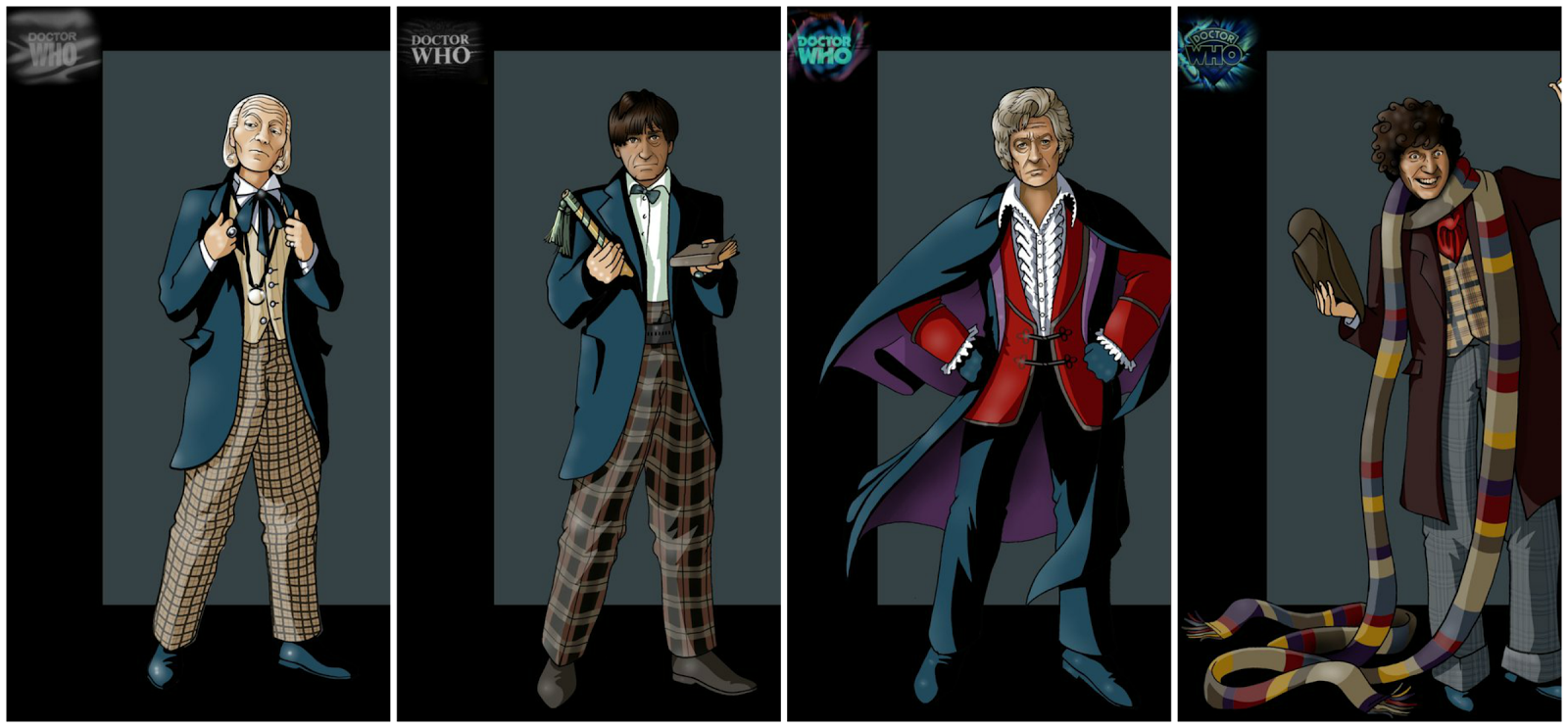


— Fahim Ferdous Kibria
The question arises because over the years we shed dead cells off our bodies to be replaced by new ones, transforming completely over decades. Thus, after a decade or so, we are a totally new composition of cells.
Is this 'me' really biologically me or someone else with my consciousness?
See how when the Doctor regenerates he has a new body and personality? And the new body has a new level of health, strength, agility and durability; new modes of thinking due to a biologically new brain pulling the strings of hormones and neurotransmitters responsible for thought and behavior. So how do we decide that it is actually him?
Similarly, as we grow older our body sheds cells when they die and our brain patterns will constantly change,
therefore altering our personality. So, in a way, everyday, in fact every hour, every minute and every second, we are regenerating into a new person entirely.
Therefore, ten years down the line, all our dead cells will be replaced by completely new ones and we will have
a different personality overall with new likes and dislikes in response to our experiences and changes in
the chemical composition of our brains. Hence the question: new cells, new personality, new everything, so how am I still me? That is when we think about regeneration and the Doctor – how do we decide he is truly the Doctor?
therefore altering our personality. So, in a way, everyday, in fact every hour, every minute and every second, we are regenerating into a new person entirely.
Therefore, ten years down the line, all our dead cells will be replaced by completely new ones and we will have
a different personality overall with new likes and dislikes in response to our experiences and changes in
the chemical composition of our brains. Hence the question: new cells, new personality, new everything, so how am I still me? That is when we think about regeneration and the Doctor – how do we decide he is truly the Doctor?
Is it because of the same memories, the events that he has gone through? Are those the deciding factors to ascertain the identity of a person? Then the question arises: what if we displace all the memories of person A into the mind of person B? Is person A, now, person B? No? Why not? Let us take this a step further.
What if we displace all the memories of person A into the mind of person B and then replace every cell in
person B's body with the cells of person A – same biological and cognitive makeup. At this point, if we kill person A, would we be able to say person A is still alive since person B is now virtually person A? Or are they – are we – defined by more than just that? Ponder about the query for even a moment if you will. Thank you.
What if we displace all the memories of person A into the mind of person B and then replace every cell in
person B's body with the cells of person A – same biological and cognitive makeup. At this point, if we kill person A, would we be able to say person A is still alive since person B is now virtually person A? Or are they – are we – defined by more than just that? Ponder about the query for even a moment if you will. Thank you.
— Fahim Ferdous Kibria
Wednesday, October 29, 2014
Metaphysics Of God

The universe is finite. Beginning from a single point in time as a constricted singularity of particles, dense and hot, and then expanding faster than the speed of light at the trillionth of a second following the Big Bang approximately 13.8 billion years ago, the universe is headed towards an end.
Stars turn into black holes, planets degrade and die, the fabric of the cosmos is ever being stretched apart by the accumulation of dark matter, and the expansion rate, after decelerating around 10.8 billion years ago due to the attractive gravitational pull of matter holding the myriad galaxies and solar systems together, has now begun to accelerate due to the repulsive gravitational push of dark energy.
Given the current knowledge of the expansion of the universe, it is an inevitable conclusion that the universe most certainly will end. As the universe expands ever faster, all of gravity's work will be undone. Clusters of galaxies will disband and separate. Then galaxies themselves will be torn apart. The solar system, stars, planets, and even molecules, quarks and atoms will be shredded down by the resultant consequences of the great cosmic phenomenon. The universe that was born in the Big Bang would end with the Big Rip: the end of all space and time and matter.

The ancient model of the endless, infinite universe has thus been proven to be false. A conceptual potential infinite aside, there can never quite be an actual infinite from a mathematical standpoint existing in the real world because the existence of an infinite number of anything leads to logical contradictions.
If the universe did not have a beginning, then the past would be infinite, that is, there would be an infinite number of past times. There cannot, however, be an infinite number of anything, and so the past cannot be infinite, and so the universe must have had a beginning, which we know as the phenomenon of the Big Bang.
Question: why do we say that an actual infinite is not realistically possible when concepts of a potential infinite exist? Proposition: Hilbert's Hotel. Hilbert’s Hotel is a hypothetical hotel with an infinite number of rooms, each of which is occupied by a guest. As there are an infinite number of rooms and an infinite number of guests, every room is occupied; the hotel cannot accommodate another guest. However, if a new guest arrives, then it is possible to free up a room for them by moving the guest in room no. 1 to room no. 2, and the guest in room no. 2 to room no. 3, so on. As for every room 'n' there is a room 'n + 1,' therefore, every guest can be moved into a different room, thus leaving room no. 1 vacant. The new guest can, then, be accommodated after all. This is clearly paradoxical; it is not possible that a hotel both can and cannot accommodate a new guest. Hilbert’s Hotel, therefore, is not possible.

Question: What if the scenario was applied to the concept of the past? Can we realistically have an infinite past? Answer: If there exists an infinite past and we were to assign a number to each moment in time of the past then every positive integer would be assigned to some moment. There would therefore be no unassigned number to be assigned to the present moment as it passes into the past. However, by reassigning the numbers and shifting them as such that moment no. 1 becomes moment no. 2, and moment no. 2 becomes moment no. 3, so on and so forth, we could free up moment number one to be assigned to the present. If the past is infinite, therefore, then there both is and is not a free number to be assigned to the present as it passes into the past.
That such a paradox results from the assumption that the past is infinite, it is claimed, demonstrates that it is not possible that that assumption is correct. The past, it seems, cannot be infinite, because it is not possible that there be an infinite number of past moments. If the past cannot be infinite, then the universe must have had a beginning. Once again, this we know as the Big Bang.
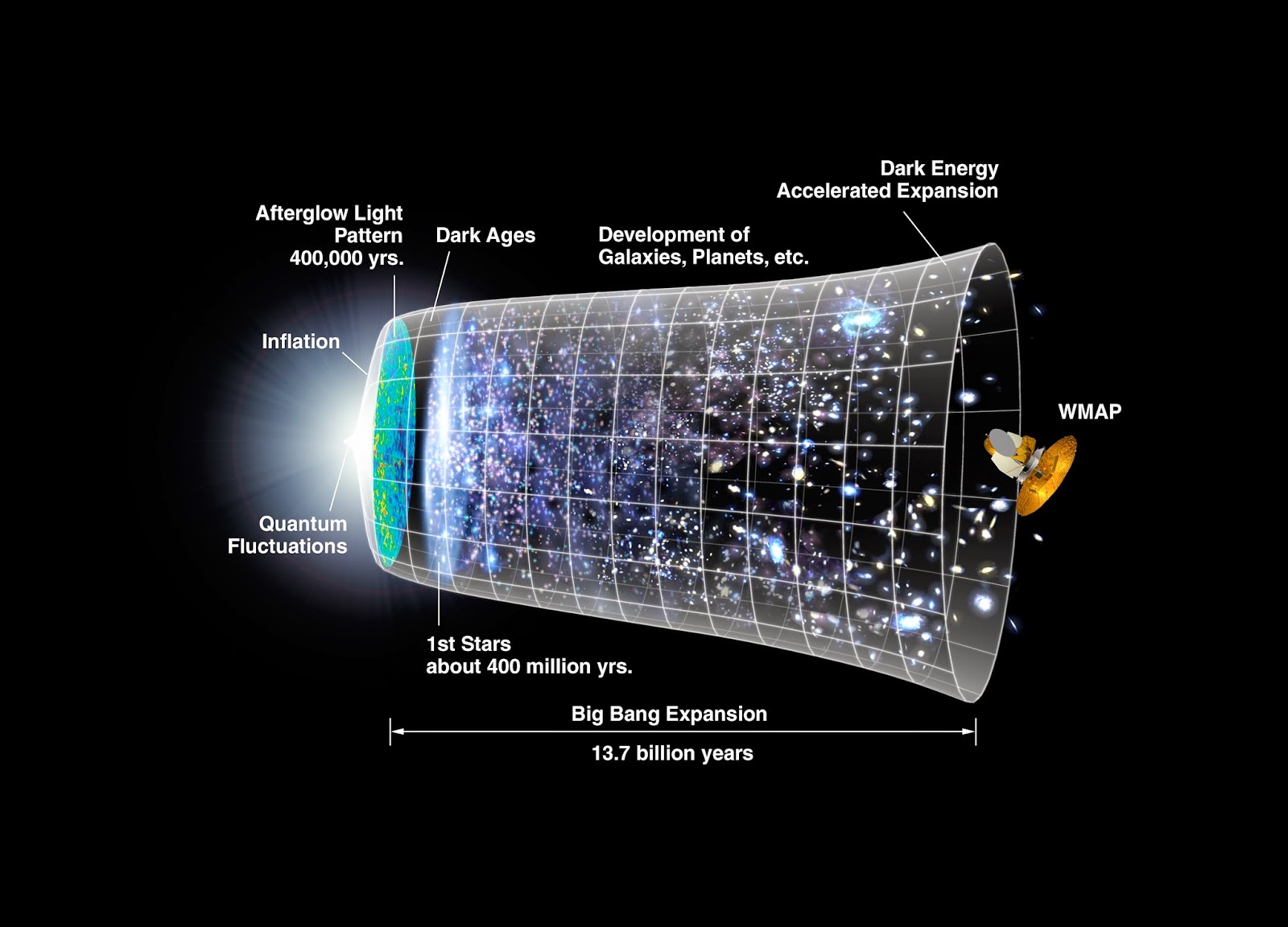
The past has been created by successive addition. The past continuously grows as one moment after another passes from the future into the present and then into the past. Every moment that is now past was once in the future, but was added to the past by the passage of time.
If actual infinites cannot be created by successive addition, and the past was created by successive addition, then the past cannot be an actual infinite. The past must be finite, and the universe must therefore have had a beginning.

Finally, we have the concept that actual infinites cannot be traversed.
If I were to set out on a journey to an infinitely distant point in space, it would not just take me a long time to get there; rather, I would never get there. No matter how long I had been walking for, a part of the journey would still remain. I would never arrive at my destination. Infinite space cannot be traversed.
Similarly, if I were to start counting to infinity, it would not just take me a long time to get there; rather, I would never get there. No matter how long I had been counting for, I would still only have counted to a finite number. It is impossible to traverse the infinite set of numbers between zero and infinity.
This also applies to the past. If the past were infinite, then it would not just take a long time to the present to arrive; rather, the present would never arrive. No matter how much time had passed, we would still be working through the infinite past. It is impossible to traverse an infinite period of time.
Clearly, though, the present has arrived, the past has been traversed.
Clearly, though, the present has arrived, the past has been traversed.
The past, therefore, cannot be infinite, but must rather be finite.
The universe has a beginning.

The evident conclusion, therefore, is this: the universe, that is, all of space, matter and time, the past, the present and the future, everything, had a beginning. Mathematically and physically speaking, the universe is finite. And this does not only hold true for our universe but for any number of universes besides this one wherein we exist that all of them is finite and not endless. Thus, even the multiverse hypothesis fails to escape the result of this conclusion.
If all of space-time started from a united compact singularity of particles, smaller than an atom, even that could not have existed forever because its very constituents are finite and finite constituents cannot compose an infinite entity. Therefore, nothing within our immediate universe is truly infinite.
And since this very particle expanding to formulate the current universe itself is finite, it must have had a beginning and there must have been something to cause it to begin. This primal cause for the beginning of every particle must, on the other hand, be infinite and eternal or else it would, too, need a cause for its own existence and that would initiate a sequence of infinite regress. There has to be something at the very beginning of everything, therefore, that transcends the need for a cause and thus be eternal. The primal cause, hence, must be an entity of infinite actuality.
Also, as consequence of what we have established earlier, this entity has to exist outside our universe and outside the boundaries of time and space as we experience it within this realm because, as the three propositions prove above, an actual infinity within the boundaries of our time and space is impossible. Time itself is built on event progression, each moment chained to another constructing a train of events moving forward towards an end. Like the numbers of the addition or the sands of the heap, these events are finite and the sum total of the events, too, are finite.

Space, also, is constituted of particles which are finite with a beginning and an end. Overall, the entirety of our universe is limited and cannot allow for an actual infinity to exist within its bounds. Therefore, for an entity of pure infinity to exist, one that is eternal with endless power and capability, the entity must exist outside the boundaries of time and space to be limitless and unbound. And thus, this entity is quite evidently transcendent beyond physicality.
This entity in proposition is God. And the premises presented above explain His Attributes in the sense that He is Infinite, He is Omnipotent and He is Eternal. He is Transcendent, beyond the boundaries of time and space and thus He has no physical body because in order to have a body, even if it was not like that of His creation, a physical body would still need to be constituted of substance meaning God would thus occupy space since all substance, composed of matter, regardless of properties, occupies space, thus limiting God to the existence of space, meaning He could not exist before the creation of space nor the matter that constructs the frame of His body which consequently also means that God would require the creation of this matter first for existence thus obstructing His Eternal Nature.
And since we have already discussed that anything within the physical reality of our universe cannot truly be infinite, this would mean that God is not an actual infinite and His capabilities are, therefore, not limitless and unbound, His existence and nature, thus, not eternal. This would severely compromise the ontological property of God and reduce Him from the primal cause into an entity caused as well as the rest of His creation which does not quite solve the problem of the genesis of the cosmos nor explain the existence of God but rather create another issue all by itself.

In other words, a physical, literal body would mean, by definition of the word "physical," a body that is bound by the laws of physics, a body that is corporeal and, therefore, limited. Anthropomorphic theologians may try to avert this possibility by claiming God to have a body unlike that of His creation but that really does not solve anything because a deer possesses a body unlike that of a gazelle and a gazelle possesses a body unlike that of a blackbuck but, speaking in general terms, having a body unlike that of another does not mean the body is not a body. A literal body is still corporeal regardless of its likeness to another body of another species or person and a corporeal body is, by definition, composed of substance and matter. Therefore, a literal body is bound by space-time. This is problematic.
A god who is bound by the space-time fabric cannot be the creator of space and time; such a scenario would be as asinine and ludicrous as a daughter giving birth to her own mother, and would be no less preposterous as the universe basically creating itself and coming into existence. We cannot attribute such a phenomenon to God and claim it to be the rationale for His Existence. This is the fundamental flaw of a creed of an anthropomorphic, physical deity.

The God of the primal cause, therefore, cannot be a deity with a literal body. He must be transcendent. And He must also be beyond any attribution of direction, that is, He cannot exist anywhere above or below, in the right or the left, the north or the south, east or west of His creation. Directions exist in reference to the plane of space, that is, they are spatial constructs, as are length, height and weight.
There would be no weight if there were no object bearing mass and there would be no height, breadth or length if there were no object possessing dimensions to be measured using arbitrary units for the calibration of these sorts of dimensions comprehensible by the human mind. Similarly, direction is also a mechanical construct to pinpoint spatial location for guidance and homing. Without space, there would be no direction, and beyond space, there would be no such concept either. Since God exists beyond and before the creation of space, He cannot be attributed any direction.
Stating that God is physically above us would mean that He exists in a plane above ourselves meaning that He exists within a spatial construct of His Own leading to the problem, once again, of limiting God to the fabric of space-time. Where was He, then, before this fabric of space was created? Is this spatial plane eternal and infinite? How is it so?
If this space existed eternally with God then no-one created it meaning God is not the Creator of this space.
This space, therefore, is beyond His Dominion limiting, then, His Sovereignty.
.jpg)
We cannot have a God stated to be the Creator of the space-time fabric existing within spatial-time constructs. Therefore, we cannot say God exists literally above us in the spatial fabric similarly as we cannot say that God came to exist in the year 4,000,000 BC. These are measurements to calibrate space and time which did not exist before the creation of space and time, therefore, they do not apply to an entity existing infinitely before time and space.
It is for this very reason that we cannot say God literally descends from His Abode at a certain time of the day or night, that would mean that, for example, God exists 3,000 feet above Earth at 12 midnight and then later climbs down to an altitude of 1,000 feet above Earth at 3 am late-night. This means God is existing within time, His position in relation to Earth changing as the hours on the clock tick away. Such an entity, bound by spatial directional relatives and time cannot be infinite nor eternal, and it is, therefore, utter blasphemy to state such claims to be literal.
This also goes in relation to any of His Acts and Attributes in the sense that saying God is now Merciful or Forgiving while He was not so last year, etc. is equally blasphemous because that is evidently saying God changes in relation to time meaning He was of a certain nature at one point in time and then another nature in the next. God does not change relative to time. He exists beyond time. This explains the Eternal Nature of His Speech too.

God does not speak of an event as it unfolds. For example, if we take the biblical narrative of Moses being told to Muhammad in the Quran, the narrative is not being recorded by God as Moses goes through his life and actions meaning that God did not wait for Moses to arrive at Mount Sinai to speak to him through the Burning Bush and then record the narrative to then narrate it to Muhammad two-thousand years later. Once again, this would mean God exists within time and space. He does not. All those events have eternally happened from the viewpoint of God.
A good way to explain this with an example would be that of a time traveler, D, arriving at a museum around 10 AM in the morning. A security guard in the museum, B, receives a phone call from the same time traveler in the future asking him to move a painting from that museum to another location elsewhere. This evidently has not happened yet in the time traveler's own timeline when he first meets the security guard. It is after traveler D enters the museum, goes through a certain series of events within the next few hours and gets trapped in a predicament around 12 noon forcing him to call the security guard, B, in the past, at 10 AM, in B's timeline that the event happens in D's timeline. However, from the viewpoint of B, that event has already unfolded two hours ago. Time is subjectively relative.

Similarly, let us say God has already spoken to Moses at Mount Sinai and narrated the tale to Muhammad before either of the two were even born. They have yet to experience it happening in their own timeline but it has already happened in the grand picture of eternity. It is their temporal states which forces them to live through their lives until the point of that event happening in their own respective timelines. Such is the Eternal Nature of God's Speech.
In other words, everything that has happened and is ever going to happen, God has already witnessed. He is in the past, present and future all at once which is why He is aware of all our actions and deeds, what will unfold now, tomorrow and in the End of Days, these are events we have initiated to pass by our own free will but God allowed it.
He has seen everything that will happen and He has thus informed of it to His Prophets and Messengers who relayed the Message to us. These matters that we have been foretold of are not to be blamed upon God as they are of our own doing. God has simply willed our desires to happen manifest, witnessed it and warned us of it so that we know.
.jpg)
Since we have established the existence of God via exposition of the primal cause, it should do well to explain why certain trends within human culture to commune with God seem to overlap with one another. If this God is Eternal and He is Conscious then He must have caused the universe to be created for a reason and He must have conveyed that reason unto His creations throughout history. We must therefore experience that communication in our own timelines as we journey through our lives and understand the nature of reality better moving forward.
Thus, it would be quite natural to see similarities in the practices and beliefs of many faiths throughout the globe as faith and religion are the routes utilized to commune with God, therefore, when God communes with Man, the same methods of communication arise repetitively, though, in time, they are corrupted and changed but the skeletal remnants are left behind as relics and bridges between the belief systems of the many tribes and nations.
This is why there are so many similarities between beliefs and theologies throughout history and culture such as the obvious existence of an Almighty Creator God, an antithetical adversary in the form of the Devil or Angra Mainyu, Prophets and Avatars, the story of Noah and Manu, an End Times messianic figure, Judgement Day, Heaven/Hell, the Bridge or the Sirat to the Final Destination of the Soul, concept of Spirits and Afterlife, ritualistic prayer services throughout the day as seen in Zoroastrianism, Judaism and Islam, a Day of Divine Remembrance in the form of the Judaic Sabbath and Islamic Jummah, among many other examples of overlaps between religions existing globally across time. These are the ties that bind us together as humanity. These are the Echoes of God.

The very reason we cannot have a corporeal primal cause is also the reason that we cannot have multiple gods or elemental ones tied to natural phenomena and abstract mortal concepts such as death. This is because for there to be an eternal god of water the existence of the element water would have to be eternal and, similarly, for there to be an eternal god of fire the existence of the element fire would have to be eternal. We know neither is eternal.
Akin to that, the concept of death would also be non-existent in a world without anything to die so death could not have existed without life and thus the concept of death is also not eternal but an aftermath of the creation of life. Therefore, there can be no eternal god of death. These can, obviously, be extrapolated for any other polytheistic conceptual or elemental god. Without their reigning concepts or elements, they would simply be gods of nothing.
A pantheistic god also poses the same dilemma in the sense that a pantheistic god is basically everything in creation meaning that the pantheistic god came into being when creation came about and not before it. Thus, the universe itself is god and the universe, therefore, created itself and then, when the universe ends, god shall end, as it came to exist when the universe came to exist. Such a god is, by definition, limited and reliant upon the finite nature of the universe and not an eternal primal cause of it, as proposed by the cosmological argument, and has no need to exist.

An Eternal God, therefore, would simply have to be, He has to exist simply because to exist is His basal nature. He is not the god of something but rather something, anything, any concept or any element, is that which He creates by nature of His Creative Act, which, is immeasurable because anything being created from infinity is not measurable from the point of infinity to its creation. This means, we can say that the universe was created 13.8 billion years ago from today but we cannot say it was created, for example, 15 billion years after infinity. Time cannot be measured from an infinite. Time is a finite concept. Finite concepts cannot be measured from an infinite starting point.
In order to explain the aforementioned statements, let us say that I started a journey from infinity to get to a given point C. I cannot say I have a walked from infinity to point C. If my initial destination is an infinite distance away from point C, I would never get to point C since the distance is infinite and shall never end. Similarly, if the universe was created 15 billion years after infinity then that would mean the span of time between the beginning of the creation of the universe and the moment before it is infinite and thus impossible to traverse. This mathematical conundrum has already been discussed far above. Infinity cannot be traversed and arbitrated using a finite set of numbers.
This is why we cannot say when God started to create the universe. We can say it came to be 13.8 billion years ago. "When" is not a concept that can be used to describe God nor His Actions and Attributes, Similarly, "where" is also not a concept that can be used to describe God and His Actions and Attributes. God only and simply exists without a "when" or a "where" for He is Infinitely Eternal. He is Omnipotent. He is Immanent. He is Almighty. He is Forever.

— Promi
The God of the primal cause, therefore, cannot be a deity with a literal body. He must be transcendent. And He must also be beyond any attribution of direction, that is, He cannot exist anywhere above or below, in the right or the left, the north or the south, east or west of His creation. Directions exist in reference to the plane of space, that is, they are spatial constructs, as are length, height and weight.
There would be no weight if there were no object bearing mass and there would be no height, breadth or length if there were no object possessing dimensions to be measured using arbitrary units for the calibration of these sorts of dimensions comprehensible by the human mind. Similarly, direction is also a mechanical construct to pinpoint spatial location for guidance and homing. Without space, there would be no direction, and beyond space, there would be no such concept either. Since God exists beyond and before the creation of space, He cannot be attributed any direction.
Stating that God is physically above us would mean that He exists in a plane above ourselves meaning that He exists within a spatial construct of His Own leading to the problem, once again, of limiting God to the fabric of space-time. Where was He, then, before this fabric of space was created? Is this spatial plane eternal and infinite? How is it so?
If this space existed eternally with God then no-one created it meaning God is not the Creator of this space.
This space, therefore, is beyond His Dominion limiting, then, His Sovereignty.
We cannot have a God stated to be the Creator of the space-time fabric existing within spatial-time constructs. Therefore, we cannot say God exists literally above us in the spatial fabric similarly as we cannot say that God came to exist in the year 4,000,000 BC. These are measurements to calibrate space and time which did not exist before the creation of space and time, therefore, they do not apply to an entity existing infinitely before time and space.
It is for this very reason that we cannot say God literally descends from His Abode at a certain time of the day or night, that would mean that, for example, God exists 3,000 feet above Earth at 12 midnight and then later climbs down to an altitude of 1,000 feet above Earth at 3 am late-night. This means God is existing within time, His position in relation to Earth changing as the hours on the clock tick away. Such an entity, bound by spatial directional relatives and time cannot be infinite nor eternal, and it is, therefore, utter blasphemy to state such claims to be literal.
This also goes in relation to any of His Acts and Attributes in the sense that saying God is now Merciful or Forgiving while He was not so last year, etc. is equally blasphemous because that is evidently saying God changes in relation to time meaning He was of a certain nature at one point in time and then another nature in the next. God does not change relative to time. He exists beyond time. This explains the Eternal Nature of His Speech too.
God does not speak of an event as it unfolds. For example, if we take the biblical narrative of Moses being told to Muhammad in the Quran, the narrative is not being recorded by God as Moses goes through his life and actions meaning that God did not wait for Moses to arrive at Mount Sinai to speak to him through the Burning Bush and then record the narrative to then narrate it to Muhammad two-thousand years later. Once again, this would mean God exists within time and space. He does not. All those events have eternally happened from the viewpoint of God.
A good way to explain this with an example would be that of a time traveler, D, arriving at a museum around 10 AM in the morning. A security guard in the museum, B, receives a phone call from the same time traveler in the future asking him to move a painting from that museum to another location elsewhere. This evidently has not happened yet in the time traveler's own timeline when he first meets the security guard. It is after traveler D enters the museum, goes through a certain series of events within the next few hours and gets trapped in a predicament around 12 noon forcing him to call the security guard, B, in the past, at 10 AM, in B's timeline that the event happens in D's timeline. However, from the viewpoint of B, that event has already unfolded two hours ago. Time is subjectively relative.
Similarly, let us say God has already spoken to Moses at Mount Sinai and narrated the tale to Muhammad before either of the two were even born. They have yet to experience it happening in their own timeline but it has already happened in the grand picture of eternity. It is their temporal states which forces them to live through their lives until the point of that event happening in their own respective timelines. Such is the Eternal Nature of God's Speech.
In other words, everything that has happened and is ever going to happen, God has already witnessed. He is in the past, present and future all at once which is why He is aware of all our actions and deeds, what will unfold now, tomorrow and in the End of Days, these are events we have initiated to pass by our own free will but God allowed it.
He has seen everything that will happen and He has thus informed of it to His Prophets and Messengers who relayed the Message to us. These matters that we have been foretold of are not to be blamed upon God as they are of our own doing. God has simply willed our desires to happen manifest, witnessed it and warned us of it so that we know.
Since we have established the existence of God via exposition of the primal cause, it should do well to explain why certain trends within human culture to commune with God seem to overlap with one another. If this God is Eternal and He is Conscious then He must have caused the universe to be created for a reason and He must have conveyed that reason unto His creations throughout history. We must therefore experience that communication in our own timelines as we journey through our lives and understand the nature of reality better moving forward.
Thus, it would be quite natural to see similarities in the practices and beliefs of many faiths throughout the globe as faith and religion are the routes utilized to commune with God, therefore, when God communes with Man, the same methods of communication arise repetitively, though, in time, they are corrupted and changed but the skeletal remnants are left behind as relics and bridges between the belief systems of the many tribes and nations.
This is why there are so many similarities between beliefs and theologies throughout history and culture such as the obvious existence of an Almighty Creator God, an antithetical adversary in the form of the Devil or Angra Mainyu, Prophets and Avatars, the story of Noah and Manu, an End Times messianic figure, Judgement Day, Heaven/Hell, the Bridge or the Sirat to the Final Destination of the Soul, concept of Spirits and Afterlife, ritualistic prayer services throughout the day as seen in Zoroastrianism, Judaism and Islam, a Day of Divine Remembrance in the form of the Judaic Sabbath and Islamic Jummah, among many other examples of overlaps between religions existing globally across time. These are the ties that bind us together as humanity. These are the Echoes of God.
The very reason we cannot have a corporeal primal cause is also the reason that we cannot have multiple gods or elemental ones tied to natural phenomena and abstract mortal concepts such as death. This is because for there to be an eternal god of water the existence of the element water would have to be eternal and, similarly, for there to be an eternal god of fire the existence of the element fire would have to be eternal. We know neither is eternal.
Akin to that, the concept of death would also be non-existent in a world without anything to die so death could not have existed without life and thus the concept of death is also not eternal but an aftermath of the creation of life. Therefore, there can be no eternal god of death. These can, obviously, be extrapolated for any other polytheistic conceptual or elemental god. Without their reigning concepts or elements, they would simply be gods of nothing.
A pantheistic god also poses the same dilemma in the sense that a pantheistic god is basically everything in creation meaning that the pantheistic god came into being when creation came about and not before it. Thus, the universe itself is god and the universe, therefore, created itself and then, when the universe ends, god shall end, as it came to exist when the universe came to exist. Such a god is, by definition, limited and reliant upon the finite nature of the universe and not an eternal primal cause of it, as proposed by the cosmological argument, and has no need to exist.
An Eternal God, therefore, would simply have to be, He has to exist simply because to exist is His basal nature. He is not the god of something but rather something, anything, any concept or any element, is that which He creates by nature of His Creative Act, which, is immeasurable because anything being created from infinity is not measurable from the point of infinity to its creation. This means, we can say that the universe was created 13.8 billion years ago from today but we cannot say it was created, for example, 15 billion years after infinity. Time cannot be measured from an infinite. Time is a finite concept. Finite concepts cannot be measured from an infinite starting point.
In order to explain the aforementioned statements, let us say that I started a journey from infinity to get to a given point C. I cannot say I have a walked from infinity to point C. If my initial destination is an infinite distance away from point C, I would never get to point C since the distance is infinite and shall never end. Similarly, if the universe was created 15 billion years after infinity then that would mean the span of time between the beginning of the creation of the universe and the moment before it is infinite and thus impossible to traverse. This mathematical conundrum has already been discussed far above. Infinity cannot be traversed and arbitrated using a finite set of numbers.
This is why we cannot say when God started to create the universe. We can say it came to be 13.8 billion years ago. "When" is not a concept that can be used to describe God nor His Actions and Attributes, Similarly, "where" is also not a concept that can be used to describe God and His Actions and Attributes. God only and simply exists without a "when" or a "where" for He is Infinitely Eternal. He is Omnipotent. He is Immanent. He is Almighty. He is Forever.
— Promi
Saturday, October 4, 2014
The Spirit, the Heart and the Soul

the desire to eat, sleep, procreate, etc. God installed this within us to ensure that we don't die out.

The ruh is the spirit which is the loci of life. It is composed of the will to reconcile with God. It inclines towards righteousness, piety, etc. The qalb is the component, often translated to heart, that balances between the two, keeping in check feelings of selfishness and selflessness so one maintains a calibrated scale of both in character.

Angels are composed simply of ruh because they don't need to eat, sleep, procreate, etc. and thus they have
no requirement for a control center of such desire in place. They are immortal spirits and thus they have no nafs and since they have no nafs they cannot sin because sinning is caused by the unchained passions of the nafs, that is, when the nafs desires for food and the person in possession of the nafs satisfies this desire by eating that which is not lawful, it is a sin, or when the nafs desires to procreate and the person in possession of the nafs satisfies
this desire via immoral sexual intercourse, it is a sin. Angels do not and they cannot sin under any circumstances.

Since angels have no requirement to eat or procreate, etc. they have no nafs, hence their inability to sin. They are only composed of ruh and thus they are purely righteousness and piety incarnate. The jinn, on the other hand, are capable of sinning because, like humans, they too are mortal and require instincts for survival thus they come off
the factory settings with both the nafs and ruh in place. Iblis, before his fall, was a pious jinn, Azazel, but due to
his disobedience against God was stripped of his grace and morphed into the Accursed Satan.

— Fahim Ferdous Kibria
Tuesday, September 2, 2014
A Short Tract About Sects Based on the Understanding of God and Their Attributes

In a general sense, when referring to who is within the fold of Islam in respect to its various sects, what is of paramount importance is their Aqeeda which is their understanding of the metaphysics of God i.e. believing in God but not believing God is Eternal or Omnipotent puts you out of the fold of orthodox Islam. The question has less to do with labels, more with beliefs. From that sense, a Shi'a is a part of the Ahlus Sunnah whereas a Wahhabi isn't. This is because Shiites believe in God being Omnipotent, Eternal, and most significantly of all, Transcendent, whereas the Wahhabis believe that God is a physical "man above the clouds."
A primary sectarian debate revolves around who can one pray behind and this is where belief in God is essential because you are praying to God, not 'Umar ibn al-Khattab or 'Ali, so you might love 'Umar and not curse him as
the Shiites are accused of doing quite often, but if you are praying to a God who is a physical entity with limitations, then a true believer cannot pray behind you.
Belief in God should be the most crucial topic in Islamic dialogue, not keeping a beard or wearing a headscarf.
If your understanding of God is weak or compromised, you are out of the greater fold of Islam, so you may be in argument about the nuances however much you want, it matters little as long as you believe about God what is correct to be believed within the fold of Islam, that is, They are Eternal, Absolute, One, Omnipotent, Omniscient, Almighty, Transcendent, and Perfect, and that Muhammad is Their last and final Messenger. Amen!
— Fahim Ferdous Kibria
Thursday, August 21, 2014
12 Differences Between the Asha'ris and the Maturidis

Imam Abu al-Hasan al-Asha‘ri is the Imam of the Ahl as-Sunnah wa al-Jama’ah and at their forefront, followed by Imam Abu al-Mansur al-Maturidi. Some of the shuyukh have mentioned that the companions of Imam ash-Shafi‘i and his followers follow Imam al-Asha’ri in matters of doctrine and follow Imam ash-Shafi‘i in matters of law whereas the companions of Imam Abu Hanifa follow Imam al-Maturidi in doctrine and follow Imam Abu Hanifa in law.
There is no contention between the two scholars and their followers except in twelve issues. Sheikh Sa‘id Fawdah wrote in Sharh Risalah al-Ikhtilaf bayn al-Asha‘ira wa al-Maturidiyya,
It is not hidden to the reader that the scholars mentioned more than this number of issues over which there is disagreement. It seems, however, that the author chose to limit them to this number due to their obvious nature.
Firstly, Imam al-Maturidi said that takwin, creation, is an Eternal Attribute that subsists with Allah’s Being, as do all of His Attributes, and that it is distinct from that which is brought into existence, mukawwan, and that it is linked with that which is brought into existence in the world and every part of it from the time of its inception. Just as Allah’s Will is Eternal and linked with that which is willed at the time of its existence, so too is His Omnipotence Eternal and linked with that which is decreed.
Sheikh Sa‘id Fawdah wrote in Sharh Risalah al-Ikhtilaf,
In other words, takwin is a Pre-Eternal Attribute that subsists with Allah and has a contingently effective lineage with that which is brought into existence at the time it is brought into being.
For this reason, the scholars say that takwin is different from that which is brought into existence, mukawwan, because takwin is a Pre-Eternal Attribute and that which is brought into existence is contingent.
For this reason, the claim of some of the Rashawi that the Maturidis agree with them that contingents subsist within Allah’s Entity is incorrect. This is fallacious because according to the Maturidis, takwin is Pre-Eternal and not contingent. It is not to be called an Attribute in an unrestricted manner; rather it is an Attribute from which actions issue forth.
Imam al-Asha‘ri said that it is a contingent Attribute that does not subsist with Allah’s Being and according to him, it is from the Attributes of Action and not from the Eternal Attributes. As he saw it, the Attributes of Action are all contingent, such as takwin and bringing into existence and the emergence of the world with the Statement, “Be.” Therefore, according to Imam al-Asha‘ri, Takwin is a description for the self-same effective linkage of power by taking note of its effect, whereas according to Imam al-Maturidi, it is the Pre-Eternal Attribute from which the creation and that which is brought into existence come.
Secondly, Imam al-Maturidi said that the Speech of Allah, the Exalted, is not heard. rather, what is heard is that which points to it. Imam al-Maturidi said that which is heard, masmu‘, only applies to that which connects with the sense of hearing. According to him, that which connects with it are the sounds that points and indicates towards the Pre-Eternal Attribute. As for the actual Pre-Eternal Attribute, both Imam al-Maturidi and Imam al-Asha‘ri held that it has no connection with the senses and that the senses have no connection with it. The disagreement is regarding whether a Pre-Eternal Attribute being heard or not. For Imam al-Maturidi, hearing is conditioned upon the connection of the senses, and for that reason he denied that Inner Speech, kalam nafsi, can be heard.
Imam al-Asha‘ri said that it is heard – as is well known in the story of Moses. Sheikh ibn Furak said,
Two things are heard during the recitation of the reader: the voice of the reader who is reciting and the Speech of Allah the Exalted.Qadhi Abu Bakr al-Baqillani said, “Allah’s Speech is not heard in the conventional sense; rather, it is possible for Allah to allow any of His creation that He wills to hear it, contrary to customary means and contrary to it being with the medium of letters and sound.”
Imam Abu Ishaq al-Isfarayini and those who follow him said, “Allah’s Speech is not heard at all.” This was the chosen view of Imam Abu al-Manswur al-Maturidi as found in al-Bidayah.
Thirdly, Imam al-Maturidi said that the Creator of the Universe is described with wisdom, hikmah, whether that wisdom takes the meaning of knowledge. ‘ilm, or the meaning of perfection or mastery, ihkam. The Imam said that Allah is described with wisdom and that wisdom is a description of Allah’s Entity. This refers either to the knowledge of the precise or perfected actions or it refers back to the Pre-Eternal Attribute of Takwin that he affirmed. This means that mastery and precision are from the implications of Takwin.
Imam al-Asha‘ri said that if wisdom takes the meaning of knowledge then it is an Eternal Attribute that subsists with Allah’s Entity, and if it takes the meaning of perfection or mastery, then it is a contingent quality akin to Takwin, and the Entity of the Creator is not described with it.
Fourthly, Imam al-Maturidi said that Allah wills obedience or disobedience for all beings, be they essences or accidents; however, obedience occurs by Allah’s Will and Decree and His Pre-Ordainment and Predestination, Pleasure, Love and Command whereas disobedience occurs by Allah’s Will and Decree and His Predestination and Pre-Ordainment but not with His Pleasure, Love or Command. Imam al-Asha‘ri said that Allah’s Love and Pleasure are inclusive of all things just as His Will.
Sheikh Sa‘id Fawdah wrote in Sharh Risalah al-Ikhtilaf,
As for Imam al-Asha‘ri, the Ustadh reported that he believed Allah’s Love is inclusive of every accident, be it an act of obedience or an act of disobedience. This general statement suggests that Allah the Exalted loves disobedience. The correct view is that this is not the doctrine of al-Asha‘ri.
On the contrary, he said that Allah loves disobedience insomuch as He punishes on account of it, just as He loves obedience insomuch as He Rewards on account of it. There is a distinction between this and what Ustadh ibn Kamal Basha and others mentioned and ascribed to al-Asha‘ri.
Fifthly, according to Imam al-Maturidi, being legally ordered with that in which there is no capacity to endure is impermissible, whereas being burdened with that which cannot be borne is permissible. Imam al-Maturidi distinguished between being legally ordered and being burdened. According to Imam al-Asha‘ri both are permissible.
Sixthly, Imam al-Maturidi said that some of the rulings that relate to legal responsibility, taklif, are known by the intellect, because the intellect is a tool by which the goodness and evil of some things can be comprehended, and it is a tool by which the obligation of faith is comprehended, as well as the obligation of gratitude to the Giver of Bounties. The One Who makes this known and obligatory is Allah the Exalted; however, it is through the medium of the intellect, just as the Apostle made the obligations known and the One Who made things obligatory in reality is Allah the Exalted, but it was through the medium of the Prophet. Imam al-Maturidi said,
No one is excused by ignorance of his Creator due to whatever that he sees in the design and creation of the Heavens and the Earth.He also said,
Had Allah not sent a Messenger, still it would have been obligatory for creation to know Him through their intellects.Imam al-Asha‘ri said that nothing is made an obligation or a prohibition except by the Sacred Law – not the intellect, even if the intellect is able to comprehend the goodness and evil of some things. According to Imam al-Ash‘ari, all of the rulings that relate to legal responsibility are taken from Revelation.
Seventhly, Imam al-Maturidi said that the wretched person could become felicitous and the felicitous person could become wretched. Imam al-Asha‘ri said that there is no consideration given to either felicity or wretchedness except during the End, Death, and Requital.
According to Imam al-Maturidi, felicity is defined as Islam and wretchedness is defined as disbelief.
According to Imam al-Asha‘ri, felicity is dying upon Islam and wretchedness is dying upon disbelief.
Eighthly, Imam al-Maturidi said that it is rationally impermissible for disbelief to be pardoned. Imam al-Asha‘ri said that it is rationally permissible but textually impermissible. Imam al-Ash‘ari’s view is based upon a rational judgement alone, whereas Imam al-Maturidi’s view is based on observation of Allah’s Will.
Ninthly, Imam al-Maturidi said it is rationally and textually impermissible for the believers to abide eternally in the Hellfire and for the disbelievers to abide in Paradise. Imam al-Asha‘ri said that it is rationally quite permissible, but textually impermissible.
Tenthly, some of the Maturidis say that the name and the thing named, al-ism wa al-musamma, are one and same. Imam al-Asha‘ri believed that there is a distinction between the two and the “act of naming,” tasmiya. Some of them divided a name into three categories: itself, other than itself, and a third category that is neither itself nor other than itself. There is agreement that the act of naming, tasmiya, is other than them, the name and the thing named, and it is what is established with the one named. This is taken from Bidayah al-Kalam.
Eleventhly, Imam al-Maturidi said that being male is a condition for Prophethood, and consequently, he said, it is absolutely impermissible for a woman to be a prophetess. Imam al-Ash‘ari said that being male is not a condition for it, and that being female does not negate it. This is taken from Bidayah al-Kalam.
Twelfthly, Imam al-Maturidi said that the action of the servant is called an acquisition and not creation, and that the Action of the Real is called creation and not acquisition – and both are inclusive of action. Imam al-Asha‘ri said that “action” denotes the Real bringing into existence and the acquisition of the servant is called “action” only figuratively. It has been said, “That which is permissible for the Almighty to be singularly is called creation, and that which is impermissible for the Almighty to be described with is acquisition.”
The gist of this disagreement is that Imam al-Asha‘ri held that the word “action” is literal when applied to Allah since He is the Doer, and is figurative when applied to the servant. Imam al-Maturidi on the other hand, held that the word “action” is also literal when applied to the servants.
— Imam Shamsuddin Ahmed ibn Sulayman ibn Kamal Pasha, The Disagreements Between Asha'ris and Maturidis, exegesis by Sheikh Sa‘id Fawdah from Sharh Risalah al-Ikhtilaf bayn al-Asha‘ira wa al-Maturidiyya, transmitted via Sidi Terence Helikaon Nunis of A Muslim Convert Once More
Subscribe to:
Posts (Atom)