Showing posts with label Scriptures. Show all posts

Tuesday, April 21, 2015

People of the Book


A lot of people have opinions about the People of the Book. I have even heard some scholars speak with authority about them and yet speak utter nonsense. Most people have no idea who or what they are. The People of the Book, the Ahlul-Kitab, refers to three main groups of people in the Qur’an: the Sabeans, the Christians, and the Jews. It was the opinion of Caliph ‘Umar I that the Zoroastrians are included in this group and he dealt with them as such.


Surely those who believe and those who are Jews and Christians and Sabeans, any who believe in God and the Last Day and work righteousness shall have their Reward with their Lord; upon them shall be no fear, nor shall they grieve.
[Quran 2:62]

We know who are the Christians and the Jews but who are the Sabeans? Some scholars actually believe that Sabeans refer to the descendants of the followers of John the Baptist, Hazrat Yahya alayhisalam.


Twenty years after the Resurrection and Ascension of Jesus, there were still disciples of John the Baptist in Alexandria, mentioned in Acts 18:24-25 and Ephesus, mentioned in Acts 19:1-6.
Now a certain Jew, named Apollo, born at Alexandria, an eloquent man, came to Ephesus, one mighty in the scriptures. This man was instructed in the Way of the Lord: and being fervent in spirit, spoke and taught diligently the things that are of Jesus, knowing only the Baptism of John.
[Acts 18:24-25]
And it came to pass, while Apollo was at Corinth, that Paul, having passed through the upper coasts, came to Ephesus and found certain disciples.
And he said to them
Have you received the Holy Ghost since you believed?
But they said to him
We have not so much as heard whether there be a Holy Ghost.
And he said
In what then were you baptized?
They said
In John's Baptism.
Then Paul said
John baptized the people with the Baptism of Penance saying,
That they should believe in him, who was to come after him, that is to say, in Jesus.
Having heard these things, they were baptized in the name of the Lord Jesus.
And when Paul had imposed his hands on them, the Holy Ghost came upon them, and they spoke with tongues and prophesied.
[Acts 19:1-6]

They believed in God as Creator, but they did not view themselves as disciples of Jesus, and they had no experience of the Holy Spirit. There is to this day a community of 80,000 Mandean Sabeans in Iraq.


They look back to the teachings of John the Baptist, and others they view as prophets such as Seth and Abraham as recorded in their holy book, the Kanza Rama, Aramaic for ‘Great Treasure.’ As in the case of the followers of John, they practice baptism, but they do not view themselves as disciples of Jesus, nor do they speak of the Holy Spirit.

Washing with water is part of their weekly ritual, but not the bread and wine of communion. The Sabean temple in Baghdad has a crucifix that is always covered with baptismal linen to indicate it is not a Christian cross. Their explanatory model is therefore Unitarian rather than Trinitarian, and they hardly distinguish themselves from the Muslims among whom they live.


Their numbers, less than 100,000 worldwide, are dwindling because nobody can be converted into their community. One has to be born into the Sabean faith.

There are also people who believe that Zoroastrians and the Yezdis are Ahlul-Kitab. The Mughal Emperor of India, Jalaluddin Muhammad Akbar, reigned from 1556 to 1605, controversially ruled that the Hindus are Ahlul-Kitab to allow his marriage to a Hindu Princess from Rajput, the one often erroneously referred to as Jodha Bai.


As was the opinion of the ‘Umar ibn al-Khattab and many classical scholars of Islam thereafter familiar with the Persians, Zoroastrians are considered Ahlul-Kitab. After the conquest of Sassanid Persia, they were treated as such. However, since they are not explicitly mentioned in the Qur’an as with regards of permissibility to marry them, Muslims are not allowed to wed Zoroastrians without willful conversion of the non-Muslim. The verse identifying the Ahlul-Kitab lawful for marriage does not mention Zoroastrians.


On this day, all things good and pure are made lawful unto you: the food of the People of the Book is lawful unto you and yours is lawful unto them; lawful unto you for marriage are not only chaste women who are Believers of the Quran, but chaste women among the People of the Book, revealed before your time, when ye give them their due dowers, and desire chastity, not lewdness, nor secret intrigues. If anyone rejects faith knowingly, fruitless is his work, and in the Hereafter he will be in the ranks of those who have lost all spiritual good.
[Quran 5:5]

The teachings of Zoroaster include belief in One Creator: Ahura Mazda. They believe in angels and a concept similar to the Day of Judgment. On the Day of Judgement, the assembled have to cross a bridge called Sirat. The bridge is as wide as your deeds. Those who fail will fall into a place of fire called Jahanamae. The faithful will be rewarded with a heavenly abode called Paradisae. This is the origin of the English word ‘Paradise.’


Interesting fact, Mithra or Mithras was one of the Avesta, the Archangels of Ahura Mazda, who eventually was worshiped as a god in his own right in the Near East. This eventually spread to the Roman Empire and the religion of Mithras challenged the nascent Christian sect of Judaism before being absorbed by it. The vicarious sacrifice, death and resurrection of Mithras after three days and the celebration of his birth, 25th December, by giving presents wrapped in coloured cloth was thought to be the origin of the Christian celebrations of Lent, culminating in Easter, and Advent, culminating in Christmas. But this is uncertain and it could be Christianity that influenced the former.


As for the Yezdis, they are a mysterious religion from the northern half of the Fertile Crescent.
Their Holy Site is Lalish near Mosul in Iraq.


Ultimately, we are unsure of the origins of the religion, where it actually started, when it began and so forth. The principal reason is because the primary adherents of the faith, the Kurds, are an insular people. Thus information about the faith is difficult to come by. Furthermore, the language of their religious texts, the Mishefa Res and the Kiteba Cilwe, is Kurmanji, a Northern Kurdish dialect.


Yezdism has many similarities with Christianity and Islam but there are principal differences. The origin of the term 'Yezdi' itself is uncertain. The Yezdis themselves believe that their name is derived from the word ‘Yezdan’ or ‘Ezid,’ which means God in their language. Some scholars have derived the name Yezdi from Old Iranian 'Yazata' meaning 'Divine Being,' while others say it is a derivation from the accursed Umayyad Caliph Yazid I, Yazid ibn Mu’aviye, said to have been revered by the Yezdis as an incarnation of the divine figure, Sultan Ezi. This derivation of the name is no longer accepted. As to whether they revere Yazid I as an Avatar of the Divine Sultan is not established but religions norms such as these hardly change.


The Yezdis believe that God created the world with the help of a Heptad of Archangels also known as Heft Sirr, the Seven Mysteries. The Ruler of these Archangels, who are analogous to the Christian and Muslim Archangels, is Melek Taus. He is also known as Shaytan. The story of Iblis and Adam in the Mishefa Res is almost the same as in the Qur’an, but, whereas in the Qur’an, Iblis was rebuked for refusing to bow before Adam, the Yezdis revere him for it since they believe the source of evil is the Heart of Man himself.


God first created Melek Taus from his own illumination, Rohani, and the other six archangels were created later. God ordered Melek Taus not to bow to any other being but Himself. Then God created the other archangels and ordered them to bring Him dust, ax, from the Earth, erd, and build the body of Adam. Then God gave life to Adam from His Own Breath and instructed all archangels to bow down to Adam. All of the archangels obeyed except for Melek Taus. In answer to God, Malek Taus exclaimed,
How can I submit to another being?! I am from your illumination while Adam is made of dust!
Then God praised him and made him the Leader of all Archangels and His Deputy on the Earth.


Yezdis also believe that the Heptad are periodically reincarnated in human form, Avatars, called ‘koasasa.’ There is also a belief in the reincarnation of lesser Yezdi souls. It is the Yezdi belief that Satan is the Ruler of the World and their veneration of Yazid ibn Mu’aviye as an Avatar in a predominantly Muslim, principally Shi’a area, that has consequently led to massive discrimination and periodic persecution.


Yazid ibn Mu’aviye the Accursed, killed Imam Husayn at Kerbala, had him decapitated and paraded throughout the empire. He mocked the severed head of Husayn in his court. Many of those present cried at the desecration of the head of the grandson of Prophet Muhammad salallahu alayhisalam. Some of them left and never returned to Damascus. He attacked Mecca, killed many of the Prophet's Noble Companions and their families, set fire to the Kaaba and persecuted the Ahlul-Bayt, the People of the Prophetic Household. He stabled animals in Masjid Nabawi, the honored mosque housing the tomb of the Prophet. His soldiers raped the womenfolk of Mecca. He was known to have led the fajr salah in a state of intoxication. When admonished by the scholars, he said that if they did not like it, he could lead them in another two raka’at. He was a known pedophile and fornicator and he molested young boys. When he was killed, his body was cut to pieces and fed to his dogs. There was nothing left to bury.


For the most part, despite the contention of many scholars, when we talk about the Ahlul-Kitab, we generally mean the Christians and the Jews. The Sabeans are, for the most part, extinct. The term, Ahlul-Kitab, is a term of honor. The People of the Book are accepted as Believers of Allah and the Keepers of the Covenants: the Noahide, Abrahamic and Mosaic Laws. They are acknowledged in the Qur’an as the nearest to us in belief and affection.


…and nearest among them in love to the believers wilt thou find those who say: "We are Christians" because amongst them are men devoted to learning and men who have renounced the world for the Sake of God, and they are not arrogant.
[Quran 5:82]


— Sidi Terence Helikaon Nunis of A Muslim Convert Once More

Thursday, October 16, 2014

No Compulsion in Religion

If the tongue says 'I believe' for the gun is held to the head yet the heart denies the lips, then such faith is fruitless.
Let there be no compulsion in religion. Truth has been made clear from falsehood.
Whoever rejects false worship and believes in God has grasped the most trustworthy handhold
that shall never break; and God is All-Hearing, Omniscient.
[Quran 2:256]


— Fahim Ferdous Kibria

Wednesday, October 15, 2014

Knowledge

Knowledge is Power
~ Sir Francis Bacon

There is nothing more important than knowledge and education. What is the main cause of fear? Lack of knowledge. We fear what we don't understand.

This is why the Zoroastrians portray God as Ahura Mazda, the Light of Wisdom, whereas the Devil is depicted as Ahriman or Angra Mainyu, the Torrential Abyss of Ignorance.

Fear, hatred, sin and malevolence – they are all the products of ignorance. This is why the Devil is the Darkness for if God is Light and God is Knowledge, then Knowledge is Light and Evil is the lack of Knowledge i.e. the lack of Light which is Darkness. This is the Wisdom of the Zoroastrian faith.


There is a reason the central codex of every religion lies within a text, within words. There is a reason God did not choose to reveal Themselves to us with angels descending from the sky on a carpet of clouds. There is a reason that They chose to leave Their Mark in the hearts of humankind through the Word: the Torah, the Gospel, the Quran, the Vedas, the Avesta, whatever it may have been, it has always been in words and the richest of words at that.

The Torah laid down in the most esoteric of Hebrew words, the Quran written in the most poetic of Arabic,
the words have remained unmatched in eloquence throughout all of time and history, and what is it that you need to understand words, to read? Education. Knowledge. God wanted us to learn, to have the ability to read, to understand and comprehend. They preserved Their Remembrance throughout the ages in words and this is
what we need most to understand Them and Their creation. We need knowledge.

Knowledge is the Path to Salvation. Ignorance is the Path to Damnation.


— Fahim Ferdous Kibria

Thursday, July 10, 2014

Essentials of Islam — Articles of Belief

Assalam Walaikum.

In the last article we discussed the essence, importance and transmission of knowledge along with the fundamentals of Faith as recorded in the Hadith of Gabriel. In this article we will be taking a closer look at them and expound upon:
  • The penultimate Verse of al-Baqarah and its role in explaining the conviction and attitude of the believer
  • Faith in Allah and what it entails
  • Our understanding of Allah, His Attributes and His Characteristics
  • Our understanding of the Angels in Heaven
  • Our understanding of Allah's Prophets, their Message and our rights towards them
  • The Day of Resurrection and the Final Reckoning
  • Divine Pre-Ordainment and Destiny

We start with the first topic on our list, the two-hundred and eighty-fifth ayat of Suratul Baqarah,
Amana ar-rasoolu bimaonzila ilayhi min rabbihi wa al-muminoona kullun amana billahi wa malaikatihi wa kutubihi wa rusulihi la nufarriqu bayna ahadin min rusulihi wa qaloo samiaana waataa ana ghufranaka rabbana wa ilayka al-maseer
Meaning,
The Messenger has believed in what has been revealed to him from his Lord, and so have the believers. All of them have believed in God and His angels and His books and His messengers, saying, "We make no distinction between any of His messengers." 
They say, "We hear and we obey. We seek Your forgiveness, our Lord, and to You is the Return."

This verse succinctly summarizes all the tenets that a Muslim is to believe along with listing the attitude of the believer towards the Commandments of the Lord, that is, the believer affirms his faith in God, convicting in his heart that He exists and He is the Supreme Ruler of All; his faith in the angels, though he cannot see them nor hear them without the Will of Allah; his faith in the Revealed Books, believing all that is in them to be true and obeying all their Laws without question; his faith in the Prophets, that they were infallible and all they spoke of is the truth and what they brought forth is to be obeyed; his faith in the Divine Ordainment from the Lord and the Return to Him in the End, the Day of Judgment. These are the constituents of Imaan.

Linguistically, "Imaan" means "to confirm." In Islam, "Imaan" means to confirm upon oneself that the Existence of Allah is true and whatever He sent unto us through His angels to His Prophets by means of His Books is undeniably His Word, His Law and He is the Sole Authority in the Heavens and the Earth and there is none who can protest against Him. Whatever He decrees as right is right and whatever He decrees as wrong is wrong. There is to be no argument, no question against His Will and His Design. The attitude of the believer to any of His Commands is always to say, "We hear and we obey." The Athari school of Islamic theology classifies this category of faith as Tawhid ar-Rububiyyah, that is, Oneness in Authority of Lordship. God is One and His Sovereignty encompasses all of existence and beyond, the seen and the unseen. Only He has the Authority to forgive and foresee what is to come. He shall remain forever. The Final Destination of every spirit is to Him and He is the Supreme Judge of them All. There is no Authority but He; a believer believes this, he hears and he obeys.


Now let us move on to our understanding of God. Who is God? God is Allah, Glorified and Exalted is He. We believe He is Living, Eternal, free of all imperfections. He is One and there is none equal to Him. He is Self-Subsisting and free of any need, material or spiritual. He requires the aid of no-one and all that exists requires the aid of Him. Nothing can exist except through His Will, His Power and His Knowledge. There is nothing in being that exists independent of Him and out of His reach. He is Immanent, Omnipotent and Omniscient. He is the Necessary Being whose Existence is the prime necessity for all other beings to exist. Therefore, everything else is a derived being, resultant of His act of Creation. These are the primary principles of definition of our understanding of God.


Qulhu Allahu Ahad
Allahu-s-Samad
Lamyalid walamyulad
Walam yakun lahu kufwan ahad
Meaning,
Say, He is God, the One
God, the Eternally Independent
He begets not nor is He begotten
There is no likeness of Him nor equal 
   

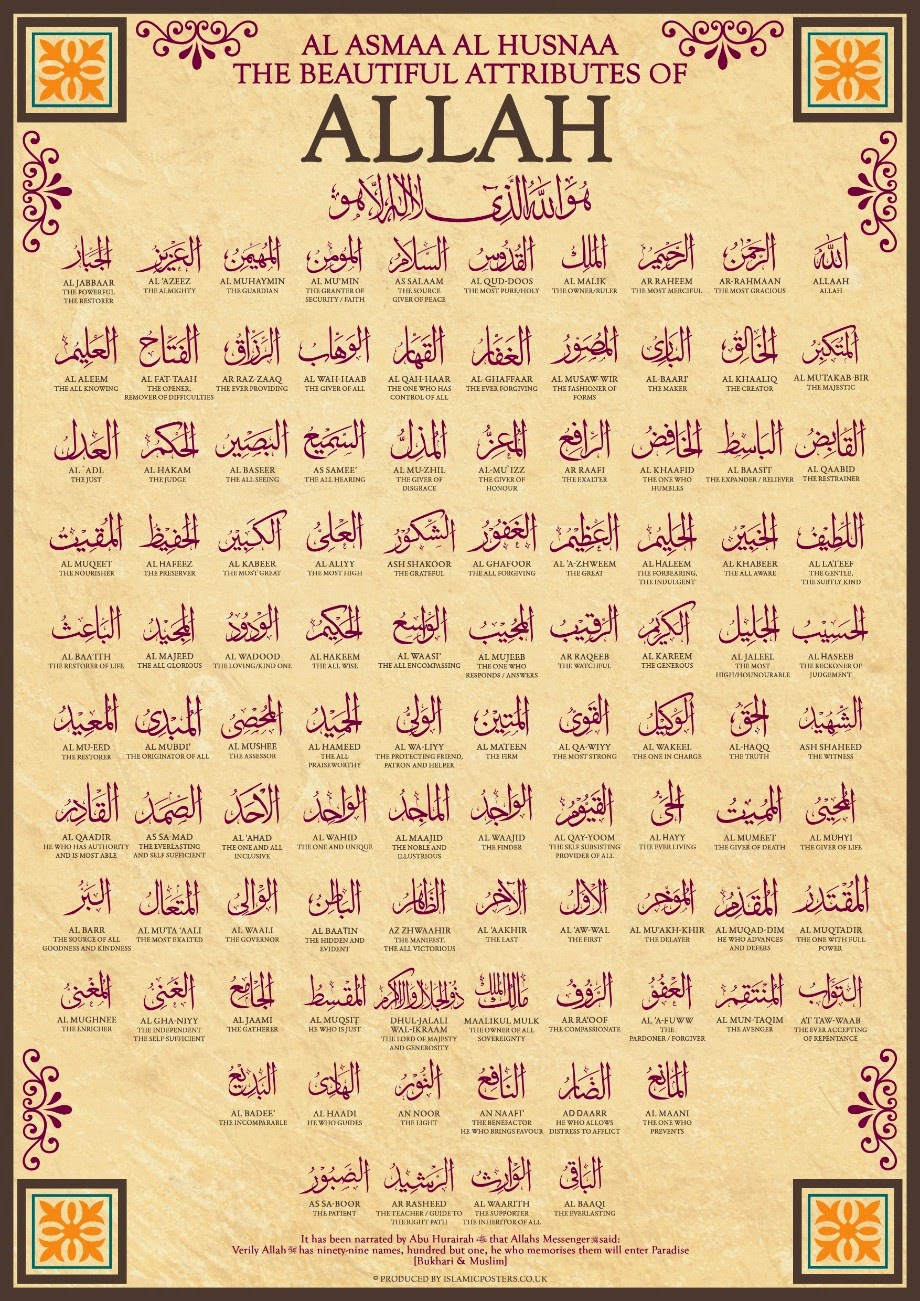
Next, we look into the Attributes of Allah. Regarding the Attributes of Allah, we believe in all Names and Attributes of Him that He imposes upon Himself in the Quran. These are known as the Ninety-Nine Beautiful Names of Divinity (Asma al-Husna). We believe that Allah is described by all that is perfect and exalted beyond all that is imperfect. There is nothing in creation that bears any likeness unto Him. In Atharism this is called Tawhid al-Asma as-Sifaat.

The Attributes of Allah subhana wa ta'ala can be classified into three categories: Personal, Negative and Affirmative. His Personal Attribute is that of Being, that is, He exists. His Negative Attributes are those that negate all characteristics which may tarnish His Absolute Perfection and Divinity. His Affirmative Attributes are those which characterizes Him and all other Attributes of His derive back to these.

In the above paragraph we looked into the basic definitions of the three categories of Allah's Attributes and pinpointed what the first of the three entails. Following this paragraph, we are going to look into the latter two of them: the Negative and the Affirmative. Starting off, let's see the Negatives:

There are five of these,
  1. Beginninglessness: This negates the perception that God can have a beginning and thus He is limited by time. Allah subhana wa ta'ala created Time and therefore He is not bound by it. His Existence is Eternal.
    Rather, Time is bound by Him.
  2. Endlessnessness: This negates the perception that God can have an end.
    Allah subhana wa ta'ala shall never cease to exist.
    He neither has a beginning nor an end. He is Ever-Living, Infinite.
  3. Oneness: This negates the perception that God is more than one, that is, there exists co-equals to Him in Power and Authority. There is no Might equal to His. He is Almighty, All-Powerful.
  4. Self-Subsistence: This negates the perception that God is in need of food and rest. God is Self-Sustaining, Independent and free of any need. Rather, all in existence needs Him yet He is beyond the need of all.
  5. Absolute Uniqueness: This negates the perception that God is like any of His creations or anything in creation is like Him. There is no likeness unto Him in all of existence. Anything that comes to mind of the visage of God is not Him. Our limited mind and senses cannot perceive Him. All His Attributes are uniquely His.
    He does not see as we humans see nor hear as we hear. His Greatness is Tremendous, His Wrath is Terrifying and His Mercy is Infinite. This is the core idea of Tawhid al-Asma as-Sifaat. None of His Attributes are like that of any of His servants. He is absolutely dissimilar to all that exists.
Now, let us look at the Affirmative Attributes of Allah subhana wa ta'ala. There are seven of these,
  1. Life: This is the prerequisite for all the other Attributes. Not all things in existence possess knowledge or will. An entity has to be alive to possess these. Allah subhana wa ta'ala is Living and Ever-Living.
  2. Knowledge: Allah subhana wa ta'ala has absolute knowledge of all things. This knowledge is not partial nor changing. Allah does not know of a thing or event as it unfolds. Rather, His Knowledge of it is there before it has already happened because Allah is beyond the boundaries of Time. He sees the past, present and future all at once and His Knowledge does not increase nor decrease. His Knowledge is not acquired nor altered. Allah subhana wa ta'ala is All-Wise, Omniscient, Supreme.
  3. Will: Everything happens by Allah's Will. Whatever He intends to pass shall come to pass. He says "Be" and it is. The Will of Allah is bound by none and encompasses all that exists, has existed or will come to exist.
    His Will extends beyond existence and creation. Rather, all that exists in creation exists only by His Will.
    Allah subhana wa ta'ala, glorified is He, Exalted and Mighty, King of all Kings.
  4. Power: Allah subhana wa ta'ala is Omnipotent. There is nothing impossible for Him even though the creation may perceive it to be impossible. He can do anything without means or effort. No act is beyond His Grasp.
  5. Speech: Allah speaks but not as the creature speaks through tongues and language.
    Rather, His Speech, like Him, is Eternal.
  6. Sight: Allah sees but not as the creature sees through eyes and light. Rather, His Sight encompasses all, whether they be in the dark or the light, in the depths of the ocean or the heights of the heavens. There is nothing in existence beyond Allah's Sight.
  7. Hearing: Allah hears but not as the creature hears through ears and sound. Rather, His Hearing is absolute. Not a leaf falls in a garden nor a drop of rain that He does not hear. Allah subhana wa ta'ala hears and answers the call of all who beckon to Him.

These are the Supreme and Divine Attributes of Allah, Unique to Him, and we believe in all of them for disbelief in any of it is tantamount to kufr and renders one beyond the fold of Islam. May Allah subhana wa ta'ala protect us all. Ameen.

Understanding these Attributes is paramount for a believer as it increases one in piety and God-consciousness (taqwa). It is a testament to the Awesome Grandeur of Allah and why He, and Only He, deserves to be worshiped. Atharites call it Tawhid al-Uluhiyyah.

Comprehension of the Divine Oneness of God in Lordship, Visage and Divinity, and frequent Remembrance of it is the Key to increasing Faith because it reminds us then that God exists, His Power is real, His Judgment is Just and He sees, hears and knows all. This reminder steers one away from sin and strengthens their conviction to do good. After all, how can one disobey God and commit sin as he remembers to himself that he is constantly within the Sight, Reach and Knowledge of God?

Moving on to the next tenet of faith, we believe in Allah's angels. We believe that the angels exist and they are true living beings, not metaphors for the forces of nature or anything as such. The angels that have been mentioned about in the Quran and Ahadith are literal and real. We believe that the angels are sinless and entirely incapable of disobeying any of God's Commands regardless of whatever it may be. The angels have the ability to question their Lord but never to go against what He says. Thus they have no free will.


The angels in Heaven are pure, infallible beings, fearsome entities created out of pure, holy light. They spend day and night worshiping God tirelessly without any exhaustion encompassing them. Their existence is a reality and denying it is kufr. May Allah subhana wa ta'ala save us from that. Ameen.


The angels whose names and roles we know about specifically are:

Gabriel, also known as Gibril or Jibreel. He is the greatest of all the angels and archangels. He is the Ruh al-Quds, the Holy Spirit. His primary role is to relay Revelation unto the Prophets from their Lord. He was responsible for inspiring Jesus with the Gospel and Muhammad with the Quran. He was also the one to bestow glad tidings of the Birth of Jesus to Mary and the Birth of John to Zechariah. He was one of the two viziers of Muhammad in Heaven, as Abu Bakr and Umar ibn al-Khattab was on Earth, the other being Mikhail. He assisted the Muslim army against the pagans of Mecca during the Battle of Badr.

Michael, also known as Mikael or Mikhail. He is the Sword of Heaven, the one who, at the Command of God, cast out Azazel from the Garden as he lost his Grace and became Iblis, the Accursed. Legend has it that when Mikhail witnessed the creation of Hell, he was so petrified by it, he never smiled again. He was one of the two viziers of Muhammad in Heaven, as Umar ibn al-Khattab and Abu Bakr were on Earth, the other being Jibreel. The duo were also the first ones to obey God's Order to bow down to Adam following his genesis. Michael and his troops assisted the Muslim army against the pagans of Mecca during the Battle of Badr.

Raphael, also known as Israfil, the Archangel of the Trumpet and Herald of the Day of Judgment. When the Hour arrives, by the Command of God, he shall blow into his Horn twice. At the first, all creatures in existence shall die. Then, at the second, all creatures in existence shall be resurrected once again. Thus, the Final Hour shall then begin. May Allah subhana wa ta'ala protect us. Ameen.

Azrael, the Archangel of Death. He sits by a tree whose leaves bear the names of all humans in existence. When a leaf falls, that person's time is up and Azrael reaps their soul. On the Final Day, before the Resurrection, he shall reap the souls of his fellow angels too. Then, all shall be granted life once again.


Our next tenet of faith is belief in the Revealed Books. We believe these books are God's answer to mankind's pleas for Guidance. They are manifestations of Divine Mercy as they are mankind's means of finding true contentment and complete fulfillment in life. We believe such books were revealed to people of every tribe and every nation in their respective languages. Of the books revealed to Man by God, the ones whose names have been specifically mentioned by their names and titles to us within the Noble Quran are — the Scrolls of Abraham (as-Suhuf-e-Ibrahim), the Scrolls of Moses (as-Suhuf-e-Musa), the Torah (at-Tawrat), the Psalms (az-Zabur), the Book of John the Baptist (Kitab-e-Yahya), the Gospel (al-Injeel) and the Quran itself.


Out of these, only the first and the latter two remain, of which only the last one is preserved in its most pristine form in meaning, sound, interpretation and understanding as the unchanged Word of God.

Next, we deal with the fourth tenet of faith in Islam, belief in God's Prophets and Messengers. We believe the Messengers of Allah are infallible and whatever they bring forth as Law is the Truth. There is to be no dispute against them. Whatever they preach is from God, their Message is Absolute.


The Prophets are the ones to whom Allah revealed His Guidance and granted the Wisdom to teach us how to apply it in our daily lives. Hence, the Messengers are our moral and spiritual role models whose ethics and codes of conduct we are to exemplify. Thus we believe these Messengers were exalted beyond all faults and sanctified by Divine Power and Will. They were the very embodiment of their Message.

We believe the Messengers chosen by Allah had four key attributes: they were truthful in words, righteously trustworthy in deeds, intelligent of mind, and loyal to the Cause of God and the task of conveying His Word.

It has been said that Allah has sent over a hundred thousand Messengers to people of every nation, language and tribe, of which the names of twenty-five have been clearly revealed to us. As Muslims, it is obligatory for us to believe that all of them were divinely inspired, free of sin, pure, truthful, noble, trustworthy, wise and firmly upon God's Law. To deny their existence, Message or Prophethood, or to assign unto them characteristics that are unworthy is absolute disbelief (kufr). May Allah subhana wa ta'ala save us from that. Ameen.

The names of these twenty-five Archprophets are: Adam, Idris (Enoch), Nuh (Noah), Hud (Eber), Salih (Saleh), Ibrahim (Abraham), Lut (Lot), Ismail (Ishmael), Ishhaak (Isaac), Yakuub (Jacob), Yusuf (Joseph), Ayyub (Job), Shuayb (Jethro), Musa (Moses), Harun (Aaron), Dhul-kifl (Ezekiel), Da'wuud (King David), Sulayman (King Solomon), Ilyas (Elijah), al-Yasa (Elisha), Yunus (Jonah), Zakariyya (Zechariah), Yahya (John the Baptist), Isa (Jesus) and Muhammad, peace and blessings of God be upon them all.


Other figures mentioned in the Quran and other Islamic literature who display prophetic qualities or have been disputed to be prophets by scholars but have not been explicitly mentioned as prophets are: Uzair (Ezra), Samuel, Kalib (Caleb), Khidhr (Melchizedek), Raubil (Reuben), Shimon (Simeon), Lewi (Levi), Yahud (Judah), Daan (Dan), Naftali (Naphtali), Gaad (Gad), Asher, Yissakar (Issachar), Dhibulun (Zebulun), ibn-Yameen (Benjamin), Luqman, Maryam (Mary), Dhul-Quarnain, Isaiah (Ishiya), Daniyal (Daniel), Irmiyah (Jeremiah), Yeshua ibn Nuun (Joshua), Zakariyya ibn Barakiah (Zachariah, the son of Berekiah), Zakariyya ibn Yahadiya (Zachariah, the son of Jehoiada), Shith (Seth), Shem (Sam), and Habil (Abel), peace be upon them all.

Regarding most of the aforementioned characters, a clear case can be made of their prophethood. However, for obvious reasons, such cannot be said of the sons of Jacob from Reuben to Zebulun due to their actions against Hazrat Yusuf. Therefore, the larger and most weightier consensus among the scholars is that they are not prophets. May God protect us from all misgivings. Ameen.

These are the figures whose lives, stories and teachings hold paramount value to us, whose examples we are asked to emulate in our daily lives to become a force for good in this world, repel evil and please Allah subhana wa ta'ala.

Prophet Muhammad, peace be upon him, is the Seal of all the Messengers and the Imam of all the Prophets.
He is the Mercy upon all of Mankind and as such we have seven obligations that we are to fulfill towards him.


These seven rights we owe the Prophet, sallallahu wa alayhi wa salam, are,
  1. Believe in him,
  2. Love him,
  3. Venerate him,
  4. Be grateful to him,
  5. Send blessings upon him,
  6. Follow him, and,
  7. Strive to instill his characteristics upon our hearts, formally and spiritually.
Now, in order to fulfill these aforementioned rights it is important for us to know the Prophet. Because it is nigh-impossible to love or follow someone without knowing them. Therefore, it is asked of us to seek and know the Prophet Muhammad through the aid of studying the Seerah and Shamaa'il.

Since, all the Prophets were physical manifestations of their Message and the Quran is the summation of all the previously revealed Messages, Prophet Muhammad can thus be said to be the Living Quran and, subsequently the Living Torah, Psalms and Gospel. His Characteristics and Mannerisms are those of every other Prophet before him. He is the Key to Perfection.

Moving on to the fifth tenet of faith, we have belief in the reality of Death and the Afterlife. As a Muslim, it is of grave importance to believe that Death is true and the Final Judgment is surely to come. The Prophet, peace be upon him, is narrated to have said,
"Make oft-remembrance of Death — the Destroyer of all Pleasures."

So, we are always to make frequent remembrance of Death, remember that soon we are to die and then we are to be judged for all our deeds, good or bad. We are to be taken account of and rewarded or punished depending on our level of Faith and adherence to the Law. Frequent remembrance of this is the route to avert from sin. Whenever you are tempted to sin, remind yourself this that that very act could be your very last. Remember. Remember and avoid the sin. Have hope, instead, for the Grand Reward and Eternal Bliss. This should be attitude of the believer.


The believer is to remind themselves that Death is true, the Resurrection is real and the Judgment of God is always near. The Day is fast approaching that all shall be taken to account. The Day is fast approaching that the Scales shall be brought forth and the deeds measured. The Bridge to Heaven across the Great Jaws of Hell is to be laid and the Final Crossing shall then begin. Those sound in Faith and frequent in righteous deeds shall cross the bridge in the blink of an eye while those drowning in Sin shall be burdened by the great weight of their wickedness and fall into the fiery pits of Perdition, eternally damned, condemned for their misdeeds and made to perish in everlasting agony; and the righteous shall then replenish themselves by the Fount at the Gates of Heaven. The Dew of the Sealed Nectar shall be delivered unto them by their Lord. Then they shall taste everlasting joy and pleasure. Their eyes shall be Graced by the Glorious Visage of God. Eternal Bliss awaits them.


These are the realities of Death and the Afterlife that is asked of every Muslim to believe and they are not metaphors nor allegories but rather the truth and all of it shall surely come to pass.


The last of the six Islamic tenets of faith is belief in Qadr, that is, Predestination. Regarding Qadr, it is to believe that both good and bad come from Allah. The consequences of all our choices are decreed by Allah. However, it is kufr to believe that we have no choice, as believed the Jabariyyah, because Allah has made known to us that we, and the Jinn, possess free-will. Yet, at the same time it is also kufr to believe that our actions are all independent of Allah's Will and Power, as believed the Qadariyyah. Rather, we are advised to take the middle path and believe we have free-will but our actions take place by the Will of Allah.

This is by far the most complicated of matters to understand. The best way to elucidate this is by the means of an example. Let us assume that Gary wanted to punch Ash in the face. Here, Gary is intending to punch Ash in the face and making the decision to go through with his intentions by his own free-will. Allah, knowing of Gary's intentions, creates the action of Gary punching Ash in the face by His Power and Will. Thus He allows and formulates the action that Gary intended to perform by Gary's freedom of choice. Therefore, Gary is the one accountable for it, not God. This is the belief in relation to Qadr of the Ahlus Sunnah w'al Jama'ah.


— Fahim Ferdous Kibria

Monday, April 14, 2014

Justice


"O ye who believe! Stand out firmly for justice as witnesses to God, even if it be against yourselves, your parents, or your kin, whether it be against rich or poor: for God can best protect both. Follow not the lusts of your hearts, lest ye swerve; And if ye distort justice or deal with inequity, verily God knows all that ye do."
[al-Qur'an 4:135]