Showing posts with label Creation. Show all posts
Showing posts with label Creation. Show all posts
Sunday, November 30, 2014

Friday, November 14, 2014
Unity of Existence

Shaykh al-Akbar Imam ibn Arabi al-Hatimi at-Tai termed this concept "the Unity of Existence" — al-Wahdat al-Wujud.


A common argument against the concept of al-Wahdat al-Wajud, often brought up by the Wahhabi Muslims such as the likes of Dr. Zakir Naik and Dr. Bilal Philips, is that it is Shirk in the form of Pantheism: untrue.

Pantheism is the belief that God is present in creation in the physical sense which is, thus, worshiped. This leads to paganism and idolatry as the objects in creation are directly worshiped as God, reducing Them to being bound in three-dimensional entities existing within spacetime.

In sharp contrast, Wahdatul-Wujud enhances God beyond any space, time or dimensional boundaries by stating that if everything in being was extended to infinity, nothing would remain but God. That is, a two-dimensional picture of
a house can be rendered into three-dimensional form, converting the image into an actual house with height, weight, width and length. However, if everything in existence was, similarly, rendered into infinite dimensions, then it would all cease to exist except for God. Therefore, in the greater scheme of things, we conclude, nothing exists but God.
a house can be rendered into three-dimensional form, converting the image into an actual house with height, weight, width and length. However, if everything in existence was, similarly, rendered into infinite dimensions, then it would all cease to exist except for God. Therefore, in the greater scheme of things, we conclude, nothing exists but God.


This is the Ultimate Truth. This is the Unity of Creation and All of Existence. This is Wahdat al-Wujud.

Wednesday, October 29, 2014
Metaphysics Of God

The universe is finite. Beginning from a single point in time as a constricted singularity of particles, dense and hot, and then expanding faster than the speed of light at the trillionth of a second following the Big Bang approximately 13.8 billion years ago, the universe is headed towards an end.
Stars turn into black holes, planets degrade and die, the fabric of the cosmos is ever being stretched apart by the accumulation of dark matter, and the expansion rate, after decelerating around 10.8 billion years ago due to the attractive gravitational pull of matter holding the myriad galaxies and solar systems together, has now begun to accelerate due to the repulsive gravitational push of dark energy.
Given the current knowledge of the expansion of the universe, it is an inevitable conclusion that the universe most certainly will end. As the universe expands ever faster, all of gravity's work will be undone. Clusters of galaxies will disband and separate. Then galaxies themselves will be torn apart. The solar system, stars, planets, and even molecules, quarks and atoms will be shredded down by the resultant consequences of the great cosmic phenomenon. The universe that was born in the Big Bang would end with the Big Rip: the end of all space and time and matter.

The ancient model of the endless, infinite universe has thus been proven to be false. A conceptual potential infinite aside, there can never quite be an actual infinite from a mathematical standpoint existing in the real world because the existence of an infinite number of anything leads to logical contradictions.
If the universe did not have a beginning, then the past would be infinite, that is, there would be an infinite number of past times. There cannot, however, be an infinite number of anything, and so the past cannot be infinite, and so the universe must have had a beginning, which we know as the phenomenon of the Big Bang.
Question: why do we say that an actual infinite is not realistically possible when concepts of a potential infinite exist? Proposition: Hilbert's Hotel. Hilbert’s Hotel is a hypothetical hotel with an infinite number of rooms, each of which is occupied by a guest. As there are an infinite number of rooms and an infinite number of guests, every room is occupied; the hotel cannot accommodate another guest. However, if a new guest arrives, then it is possible to free up a room for them by moving the guest in room no. 1 to room no. 2, and the guest in room no. 2 to room no. 3, so on. As for every room 'n' there is a room 'n + 1,' therefore, every guest can be moved into a different room, thus leaving room no. 1 vacant. The new guest can, then, be accommodated after all. This is clearly paradoxical; it is not possible that a hotel both can and cannot accommodate a new guest. Hilbert’s Hotel, therefore, is not possible.

Question: What if the scenario was applied to the concept of the past? Can we realistically have an infinite past? Answer: If there exists an infinite past and we were to assign a number to each moment in time of the past then every positive integer would be assigned to some moment. There would therefore be no unassigned number to be assigned to the present moment as it passes into the past. However, by reassigning the numbers and shifting them as such that moment no. 1 becomes moment no. 2, and moment no. 2 becomes moment no. 3, so on and so forth, we could free up moment number one to be assigned to the present. If the past is infinite, therefore, then there both is and is not a free number to be assigned to the present as it passes into the past.
That such a paradox results from the assumption that the past is infinite, it is claimed, demonstrates that it is not possible that that assumption is correct. The past, it seems, cannot be infinite, because it is not possible that there be an infinite number of past moments. If the past cannot be infinite, then the universe must have had a beginning. Once again, this we know as the Big Bang.
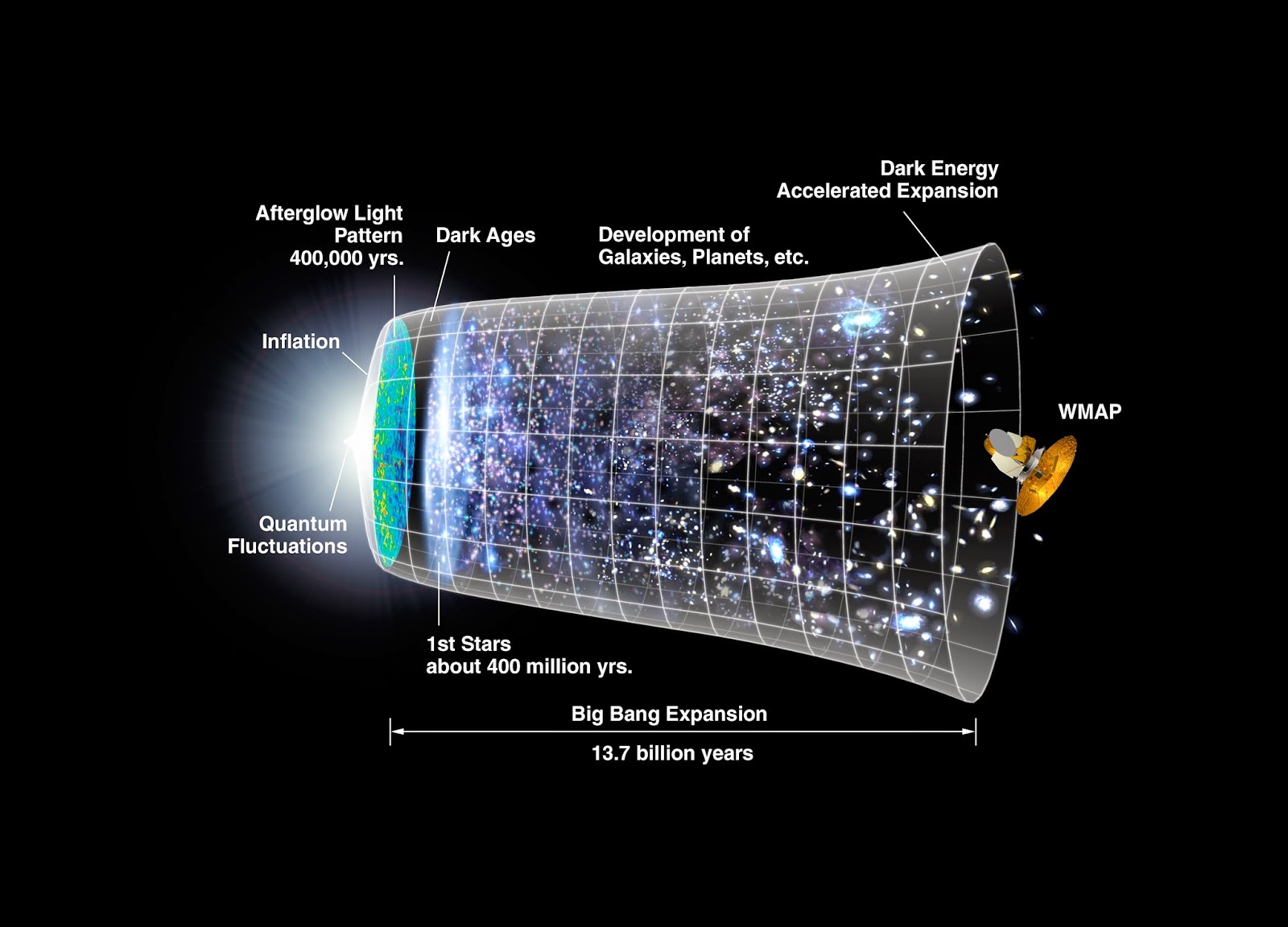
The past has been created by successive addition. The past continuously grows as one moment after another passes from the future into the present and then into the past. Every moment that is now past was once in the future, but was added to the past by the passage of time.
If actual infinites cannot be created by successive addition, and the past was created by successive addition, then the past cannot be an actual infinite. The past must be finite, and the universe must therefore have had a beginning.

Finally, we have the concept that actual infinites cannot be traversed.
If I were to set out on a journey to an infinitely distant point in space, it would not just take me a long time to get there; rather, I would never get there. No matter how long I had been walking for, a part of the journey would still remain. I would never arrive at my destination. Infinite space cannot be traversed.
Similarly, if I were to start counting to infinity, it would not just take me a long time to get there; rather, I would never get there. No matter how long I had been counting for, I would still only have counted to a finite number. It is impossible to traverse the infinite set of numbers between zero and infinity.
This also applies to the past. If the past were infinite, then it would not just take a long time to the present to arrive; rather, the present would never arrive. No matter how much time had passed, we would still be working through the infinite past. It is impossible to traverse an infinite period of time.
Clearly, though, the present has arrived, the past has been traversed.
Clearly, though, the present has arrived, the past has been traversed.
The past, therefore, cannot be infinite, but must rather be finite.
The universe has a beginning.

The evident conclusion, therefore, is this: the universe, that is, all of space, matter and time, the past, the present and the future, everything, had a beginning. Mathematically and physically speaking, the universe is finite. And this does not only hold true for our universe but for any number of universes besides this one wherein we exist that all of them is finite and not endless. Thus, even the multiverse hypothesis fails to escape the result of this conclusion.
If all of space-time started from a united compact singularity of particles, smaller than an atom, even that could not have existed forever because its very constituents are finite and finite constituents cannot compose an infinite entity. Therefore, nothing within our immediate universe is truly infinite.
And since this very particle expanding to formulate the current universe itself is finite, it must have had a beginning and there must have been something to cause it to begin. This primal cause for the beginning of every particle must, on the other hand, be infinite and eternal or else it would, too, need a cause for its own existence and that would initiate a sequence of infinite regress. There has to be something at the very beginning of everything, therefore, that transcends the need for a cause and thus be eternal. The primal cause, hence, must be an entity of infinite actuality.
Also, as consequence of what we have established earlier, this entity has to exist outside our universe and outside the boundaries of time and space as we experience it within this realm because, as the three propositions prove above, an actual infinity within the boundaries of our time and space is impossible. Time itself is built on event progression, each moment chained to another constructing a train of events moving forward towards an end. Like the numbers of the addition or the sands of the heap, these events are finite and the sum total of the events, too, are finite.

Space, also, is constituted of particles which are finite with a beginning and an end. Overall, the entirety of our universe is limited and cannot allow for an actual infinity to exist within its bounds. Therefore, for an entity of pure infinity to exist, one that is eternal with endless power and capability, the entity must exist outside the boundaries of time and space to be limitless and unbound. And thus, this entity is quite evidently transcendent beyond physicality.
This entity in proposition is God. And the premises presented above explain His Attributes in the sense that He is Infinite, He is Omnipotent and He is Eternal. He is Transcendent, beyond the boundaries of time and space and thus He has no physical body because in order to have a body, even if it was not like that of His creation, a physical body would still need to be constituted of substance meaning God would thus occupy space since all substance, composed of matter, regardless of properties, occupies space, thus limiting God to the existence of space, meaning He could not exist before the creation of space nor the matter that constructs the frame of His body which consequently also means that God would require the creation of this matter first for existence thus obstructing His Eternal Nature.
And since we have already discussed that anything within the physical reality of our universe cannot truly be infinite, this would mean that God is not an actual infinite and His capabilities are, therefore, not limitless and unbound, His existence and nature, thus, not eternal. This would severely compromise the ontological property of God and reduce Him from the primal cause into an entity caused as well as the rest of His creation which does not quite solve the problem of the genesis of the cosmos nor explain the existence of God but rather create another issue all by itself.

In other words, a physical, literal body would mean, by definition of the word "physical," a body that is bound by the laws of physics, a body that is corporeal and, therefore, limited. Anthropomorphic theologians may try to avert this possibility by claiming God to have a body unlike that of His creation but that really does not solve anything because a deer possesses a body unlike that of a gazelle and a gazelle possesses a body unlike that of a blackbuck but, speaking in general terms, having a body unlike that of another does not mean the body is not a body. A literal body is still corporeal regardless of its likeness to another body of another species or person and a corporeal body is, by definition, composed of substance and matter. Therefore, a literal body is bound by space-time. This is problematic.
A god who is bound by the space-time fabric cannot be the creator of space and time; such a scenario would be as asinine and ludicrous as a daughter giving birth to her own mother, and would be no less preposterous as the universe basically creating itself and coming into existence. We cannot attribute such a phenomenon to God and claim it to be the rationale for His Existence. This is the fundamental flaw of a creed of an anthropomorphic, physical deity.

The God of the primal cause, therefore, cannot be a deity with a literal body. He must be transcendent. And He must also be beyond any attribution of direction, that is, He cannot exist anywhere above or below, in the right or the left, the north or the south, east or west of His creation. Directions exist in reference to the plane of space, that is, they are spatial constructs, as are length, height and weight.
There would be no weight if there were no object bearing mass and there would be no height, breadth or length if there were no object possessing dimensions to be measured using arbitrary units for the calibration of these sorts of dimensions comprehensible by the human mind. Similarly, direction is also a mechanical construct to pinpoint spatial location for guidance and homing. Without space, there would be no direction, and beyond space, there would be no such concept either. Since God exists beyond and before the creation of space, He cannot be attributed any direction.
Stating that God is physically above us would mean that He exists in a plane above ourselves meaning that He exists within a spatial construct of His Own leading to the problem, once again, of limiting God to the fabric of space-time. Where was He, then, before this fabric of space was created? Is this spatial plane eternal and infinite? How is it so?
If this space existed eternally with God then no-one created it meaning God is not the Creator of this space.
This space, therefore, is beyond His Dominion limiting, then, His Sovereignty.
.jpg)
We cannot have a God stated to be the Creator of the space-time fabric existing within spatial-time constructs. Therefore, we cannot say God exists literally above us in the spatial fabric similarly as we cannot say that God came to exist in the year 4,000,000 BC. These are measurements to calibrate space and time which did not exist before the creation of space and time, therefore, they do not apply to an entity existing infinitely before time and space.
It is for this very reason that we cannot say God literally descends from His Abode at a certain time of the day or night, that would mean that, for example, God exists 3,000 feet above Earth at 12 midnight and then later climbs down to an altitude of 1,000 feet above Earth at 3 am late-night. This means God is existing within time, His position in relation to Earth changing as the hours on the clock tick away. Such an entity, bound by spatial directional relatives and time cannot be infinite nor eternal, and it is, therefore, utter blasphemy to state such claims to be literal.
This also goes in relation to any of His Acts and Attributes in the sense that saying God is now Merciful or Forgiving while He was not so last year, etc. is equally blasphemous because that is evidently saying God changes in relation to time meaning He was of a certain nature at one point in time and then another nature in the next. God does not change relative to time. He exists beyond time. This explains the Eternal Nature of His Speech too.

God does not speak of an event as it unfolds. For example, if we take the biblical narrative of Moses being told to Muhammad in the Quran, the narrative is not being recorded by God as Moses goes through his life and actions meaning that God did not wait for Moses to arrive at Mount Sinai to speak to him through the Burning Bush and then record the narrative to then narrate it to Muhammad two-thousand years later. Once again, this would mean God exists within time and space. He does not. All those events have eternally happened from the viewpoint of God.
A good way to explain this with an example would be that of a time traveler, D, arriving at a museum around 10 AM in the morning. A security guard in the museum, B, receives a phone call from the same time traveler in the future asking him to move a painting from that museum to another location elsewhere. This evidently has not happened yet in the time traveler's own timeline when he first meets the security guard. It is after traveler D enters the museum, goes through a certain series of events within the next few hours and gets trapped in a predicament around 12 noon forcing him to call the security guard, B, in the past, at 10 AM, in B's timeline that the event happens in D's timeline. However, from the viewpoint of B, that event has already unfolded two hours ago. Time is subjectively relative.

Similarly, let us say God has already spoken to Moses at Mount Sinai and narrated the tale to Muhammad before either of the two were even born. They have yet to experience it happening in their own timeline but it has already happened in the grand picture of eternity. It is their temporal states which forces them to live through their lives until the point of that event happening in their own respective timelines. Such is the Eternal Nature of God's Speech.
In other words, everything that has happened and is ever going to happen, God has already witnessed. He is in the past, present and future all at once which is why He is aware of all our actions and deeds, what will unfold now, tomorrow and in the End of Days, these are events we have initiated to pass by our own free will but God allowed it.
He has seen everything that will happen and He has thus informed of it to His Prophets and Messengers who relayed the Message to us. These matters that we have been foretold of are not to be blamed upon God as they are of our own doing. God has simply willed our desires to happen manifest, witnessed it and warned us of it so that we know.
.jpg)
Since we have established the existence of God via exposition of the primal cause, it should do well to explain why certain trends within human culture to commune with God seem to overlap with one another. If this God is Eternal and He is Conscious then He must have caused the universe to be created for a reason and He must have conveyed that reason unto His creations throughout history. We must therefore experience that communication in our own timelines as we journey through our lives and understand the nature of reality better moving forward.
Thus, it would be quite natural to see similarities in the practices and beliefs of many faiths throughout the globe as faith and religion are the routes utilized to commune with God, therefore, when God communes with Man, the same methods of communication arise repetitively, though, in time, they are corrupted and changed but the skeletal remnants are left behind as relics and bridges between the belief systems of the many tribes and nations.
This is why there are so many similarities between beliefs and theologies throughout history and culture such as the obvious existence of an Almighty Creator God, an antithetical adversary in the form of the Devil or Angra Mainyu, Prophets and Avatars, the story of Noah and Manu, an End Times messianic figure, Judgement Day, Heaven/Hell, the Bridge or the Sirat to the Final Destination of the Soul, concept of Spirits and Afterlife, ritualistic prayer services throughout the day as seen in Zoroastrianism, Judaism and Islam, a Day of Divine Remembrance in the form of the Judaic Sabbath and Islamic Jummah, among many other examples of overlaps between religions existing globally across time. These are the ties that bind us together as humanity. These are the Echoes of God.

The very reason we cannot have a corporeal primal cause is also the reason that we cannot have multiple gods or elemental ones tied to natural phenomena and abstract mortal concepts such as death. This is because for there to be an eternal god of water the existence of the element water would have to be eternal and, similarly, for there to be an eternal god of fire the existence of the element fire would have to be eternal. We know neither is eternal.
Akin to that, the concept of death would also be non-existent in a world without anything to die so death could not have existed without life and thus the concept of death is also not eternal but an aftermath of the creation of life. Therefore, there can be no eternal god of death. These can, obviously, be extrapolated for any other polytheistic conceptual or elemental god. Without their reigning concepts or elements, they would simply be gods of nothing.
A pantheistic god also poses the same dilemma in the sense that a pantheistic god is basically everything in creation meaning that the pantheistic god came into being when creation came about and not before it. Thus, the universe itself is god and the universe, therefore, created itself and then, when the universe ends, god shall end, as it came to exist when the universe came to exist. Such a god is, by definition, limited and reliant upon the finite nature of the universe and not an eternal primal cause of it, as proposed by the cosmological argument, and has no need to exist.

An Eternal God, therefore, would simply have to be, He has to exist simply because to exist is His basal nature. He is not the god of something but rather something, anything, any concept or any element, is that which He creates by nature of His Creative Act, which, is immeasurable because anything being created from infinity is not measurable from the point of infinity to its creation. This means, we can say that the universe was created 13.8 billion years ago from today but we cannot say it was created, for example, 15 billion years after infinity. Time cannot be measured from an infinite. Time is a finite concept. Finite concepts cannot be measured from an infinite starting point.
In order to explain the aforementioned statements, let us say that I started a journey from infinity to get to a given point C. I cannot say I have a walked from infinity to point C. If my initial destination is an infinite distance away from point C, I would never get to point C since the distance is infinite and shall never end. Similarly, if the universe was created 15 billion years after infinity then that would mean the span of time between the beginning of the creation of the universe and the moment before it is infinite and thus impossible to traverse. This mathematical conundrum has already been discussed far above. Infinity cannot be traversed and arbitrated using a finite set of numbers.
This is why we cannot say when God started to create the universe. We can say it came to be 13.8 billion years ago. "When" is not a concept that can be used to describe God nor His Actions and Attributes, Similarly, "where" is also not a concept that can be used to describe God and His Actions and Attributes. God only and simply exists without a "when" or a "where" for He is Infinitely Eternal. He is Omnipotent. He is Immanent. He is Almighty. He is Forever.

— Promi
The God of the primal cause, therefore, cannot be a deity with a literal body. He must be transcendent. And He must also be beyond any attribution of direction, that is, He cannot exist anywhere above or below, in the right or the left, the north or the south, east or west of His creation. Directions exist in reference to the plane of space, that is, they are spatial constructs, as are length, height and weight.
There would be no weight if there were no object bearing mass and there would be no height, breadth or length if there were no object possessing dimensions to be measured using arbitrary units for the calibration of these sorts of dimensions comprehensible by the human mind. Similarly, direction is also a mechanical construct to pinpoint spatial location for guidance and homing. Without space, there would be no direction, and beyond space, there would be no such concept either. Since God exists beyond and before the creation of space, He cannot be attributed any direction.
Stating that God is physically above us would mean that He exists in a plane above ourselves meaning that He exists within a spatial construct of His Own leading to the problem, once again, of limiting God to the fabric of space-time. Where was He, then, before this fabric of space was created? Is this spatial plane eternal and infinite? How is it so?
If this space existed eternally with God then no-one created it meaning God is not the Creator of this space.
This space, therefore, is beyond His Dominion limiting, then, His Sovereignty.
We cannot have a God stated to be the Creator of the space-time fabric existing within spatial-time constructs. Therefore, we cannot say God exists literally above us in the spatial fabric similarly as we cannot say that God came to exist in the year 4,000,000 BC. These are measurements to calibrate space and time which did not exist before the creation of space and time, therefore, they do not apply to an entity existing infinitely before time and space.
It is for this very reason that we cannot say God literally descends from His Abode at a certain time of the day or night, that would mean that, for example, God exists 3,000 feet above Earth at 12 midnight and then later climbs down to an altitude of 1,000 feet above Earth at 3 am late-night. This means God is existing within time, His position in relation to Earth changing as the hours on the clock tick away. Such an entity, bound by spatial directional relatives and time cannot be infinite nor eternal, and it is, therefore, utter blasphemy to state such claims to be literal.
This also goes in relation to any of His Acts and Attributes in the sense that saying God is now Merciful or Forgiving while He was not so last year, etc. is equally blasphemous because that is evidently saying God changes in relation to time meaning He was of a certain nature at one point in time and then another nature in the next. God does not change relative to time. He exists beyond time. This explains the Eternal Nature of His Speech too.
God does not speak of an event as it unfolds. For example, if we take the biblical narrative of Moses being told to Muhammad in the Quran, the narrative is not being recorded by God as Moses goes through his life and actions meaning that God did not wait for Moses to arrive at Mount Sinai to speak to him through the Burning Bush and then record the narrative to then narrate it to Muhammad two-thousand years later. Once again, this would mean God exists within time and space. He does not. All those events have eternally happened from the viewpoint of God.
A good way to explain this with an example would be that of a time traveler, D, arriving at a museum around 10 AM in the morning. A security guard in the museum, B, receives a phone call from the same time traveler in the future asking him to move a painting from that museum to another location elsewhere. This evidently has not happened yet in the time traveler's own timeline when he first meets the security guard. It is after traveler D enters the museum, goes through a certain series of events within the next few hours and gets trapped in a predicament around 12 noon forcing him to call the security guard, B, in the past, at 10 AM, in B's timeline that the event happens in D's timeline. However, from the viewpoint of B, that event has already unfolded two hours ago. Time is subjectively relative.
Similarly, let us say God has already spoken to Moses at Mount Sinai and narrated the tale to Muhammad before either of the two were even born. They have yet to experience it happening in their own timeline but it has already happened in the grand picture of eternity. It is their temporal states which forces them to live through their lives until the point of that event happening in their own respective timelines. Such is the Eternal Nature of God's Speech.
In other words, everything that has happened and is ever going to happen, God has already witnessed. He is in the past, present and future all at once which is why He is aware of all our actions and deeds, what will unfold now, tomorrow and in the End of Days, these are events we have initiated to pass by our own free will but God allowed it.
He has seen everything that will happen and He has thus informed of it to His Prophets and Messengers who relayed the Message to us. These matters that we have been foretold of are not to be blamed upon God as they are of our own doing. God has simply willed our desires to happen manifest, witnessed it and warned us of it so that we know.
Since we have established the existence of God via exposition of the primal cause, it should do well to explain why certain trends within human culture to commune with God seem to overlap with one another. If this God is Eternal and He is Conscious then He must have caused the universe to be created for a reason and He must have conveyed that reason unto His creations throughout history. We must therefore experience that communication in our own timelines as we journey through our lives and understand the nature of reality better moving forward.
Thus, it would be quite natural to see similarities in the practices and beliefs of many faiths throughout the globe as faith and religion are the routes utilized to commune with God, therefore, when God communes with Man, the same methods of communication arise repetitively, though, in time, they are corrupted and changed but the skeletal remnants are left behind as relics and bridges between the belief systems of the many tribes and nations.
This is why there are so many similarities between beliefs and theologies throughout history and culture such as the obvious existence of an Almighty Creator God, an antithetical adversary in the form of the Devil or Angra Mainyu, Prophets and Avatars, the story of Noah and Manu, an End Times messianic figure, Judgement Day, Heaven/Hell, the Bridge or the Sirat to the Final Destination of the Soul, concept of Spirits and Afterlife, ritualistic prayer services throughout the day as seen in Zoroastrianism, Judaism and Islam, a Day of Divine Remembrance in the form of the Judaic Sabbath and Islamic Jummah, among many other examples of overlaps between religions existing globally across time. These are the ties that bind us together as humanity. These are the Echoes of God.
The very reason we cannot have a corporeal primal cause is also the reason that we cannot have multiple gods or elemental ones tied to natural phenomena and abstract mortal concepts such as death. This is because for there to be an eternal god of water the existence of the element water would have to be eternal and, similarly, for there to be an eternal god of fire the existence of the element fire would have to be eternal. We know neither is eternal.
Akin to that, the concept of death would also be non-existent in a world without anything to die so death could not have existed without life and thus the concept of death is also not eternal but an aftermath of the creation of life. Therefore, there can be no eternal god of death. These can, obviously, be extrapolated for any other polytheistic conceptual or elemental god. Without their reigning concepts or elements, they would simply be gods of nothing.
A pantheistic god also poses the same dilemma in the sense that a pantheistic god is basically everything in creation meaning that the pantheistic god came into being when creation came about and not before it. Thus, the universe itself is god and the universe, therefore, created itself and then, when the universe ends, god shall end, as it came to exist when the universe came to exist. Such a god is, by definition, limited and reliant upon the finite nature of the universe and not an eternal primal cause of it, as proposed by the cosmological argument, and has no need to exist.
An Eternal God, therefore, would simply have to be, He has to exist simply because to exist is His basal nature. He is not the god of something but rather something, anything, any concept or any element, is that which He creates by nature of His Creative Act, which, is immeasurable because anything being created from infinity is not measurable from the point of infinity to its creation. This means, we can say that the universe was created 13.8 billion years ago from today but we cannot say it was created, for example, 15 billion years after infinity. Time cannot be measured from an infinite. Time is a finite concept. Finite concepts cannot be measured from an infinite starting point.
In order to explain the aforementioned statements, let us say that I started a journey from infinity to get to a given point C. I cannot say I have a walked from infinity to point C. If my initial destination is an infinite distance away from point C, I would never get to point C since the distance is infinite and shall never end. Similarly, if the universe was created 15 billion years after infinity then that would mean the span of time between the beginning of the creation of the universe and the moment before it is infinite and thus impossible to traverse. This mathematical conundrum has already been discussed far above. Infinity cannot be traversed and arbitrated using a finite set of numbers.
This is why we cannot say when God started to create the universe. We can say it came to be 13.8 billion years ago. "When" is not a concept that can be used to describe God nor His Actions and Attributes, Similarly, "where" is also not a concept that can be used to describe God and His Actions and Attributes. God only and simply exists without a "when" or a "where" for He is Infinitely Eternal. He is Omnipotent. He is Immanent. He is Almighty. He is Forever.
— Promi
Thursday, August 21, 2014
12 Differences Between the Asha'ris and the Maturidis

Imam Abu al-Hasan al-Asha‘ri is the Imam of the Ahl as-Sunnah wa al-Jama’ah and at their forefront, followed by Imam Abu al-Mansur al-Maturidi. Some of the shuyukh have mentioned that the companions of Imam ash-Shafi‘i and his followers follow Imam al-Asha’ri in matters of doctrine and follow Imam ash-Shafi‘i in matters of law whereas the companions of Imam Abu Hanifa follow Imam al-Maturidi in doctrine and follow Imam Abu Hanifa in law.
There is no contention between the two scholars and their followers except in twelve issues. Sheikh Sa‘id Fawdah wrote in Sharh Risalah al-Ikhtilaf bayn al-Asha‘ira wa al-Maturidiyya,
It is not hidden to the reader that the scholars mentioned more than this number of issues over which there is disagreement. It seems, however, that the author chose to limit them to this number due to their obvious nature.
Firstly, Imam al-Maturidi said that takwin, creation, is an Eternal Attribute that subsists with Allah’s Being, as do all of His Attributes, and that it is distinct from that which is brought into existence, mukawwan, and that it is linked with that which is brought into existence in the world and every part of it from the time of its inception. Just as Allah’s Will is Eternal and linked with that which is willed at the time of its existence, so too is His Omnipotence Eternal and linked with that which is decreed.
Sheikh Sa‘id Fawdah wrote in Sharh Risalah al-Ikhtilaf,
In other words, takwin is a Pre-Eternal Attribute that subsists with Allah and has a contingently effective lineage with that which is brought into existence at the time it is brought into being.
For this reason, the scholars say that takwin is different from that which is brought into existence, mukawwan, because takwin is a Pre-Eternal Attribute and that which is brought into existence is contingent.
For this reason, the claim of some of the Rashawi that the Maturidis agree with them that contingents subsist within Allah’s Entity is incorrect. This is fallacious because according to the Maturidis, takwin is Pre-Eternal and not contingent. It is not to be called an Attribute in an unrestricted manner; rather it is an Attribute from which actions issue forth.
Imam al-Asha‘ri said that it is a contingent Attribute that does not subsist with Allah’s Being and according to him, it is from the Attributes of Action and not from the Eternal Attributes. As he saw it, the Attributes of Action are all contingent, such as takwin and bringing into existence and the emergence of the world with the Statement, “Be.” Therefore, according to Imam al-Asha‘ri, Takwin is a description for the self-same effective linkage of power by taking note of its effect, whereas according to Imam al-Maturidi, it is the Pre-Eternal Attribute from which the creation and that which is brought into existence come.
Secondly, Imam al-Maturidi said that the Speech of Allah, the Exalted, is not heard. rather, what is heard is that which points to it. Imam al-Maturidi said that which is heard, masmu‘, only applies to that which connects with the sense of hearing. According to him, that which connects with it are the sounds that points and indicates towards the Pre-Eternal Attribute. As for the actual Pre-Eternal Attribute, both Imam al-Maturidi and Imam al-Asha‘ri held that it has no connection with the senses and that the senses have no connection with it. The disagreement is regarding whether a Pre-Eternal Attribute being heard or not. For Imam al-Maturidi, hearing is conditioned upon the connection of the senses, and for that reason he denied that Inner Speech, kalam nafsi, can be heard.
Imam al-Asha‘ri said that it is heard – as is well known in the story of Moses. Sheikh ibn Furak said,
Two things are heard during the recitation of the reader: the voice of the reader who is reciting and the Speech of Allah the Exalted.Qadhi Abu Bakr al-Baqillani said, “Allah’s Speech is not heard in the conventional sense; rather, it is possible for Allah to allow any of His creation that He wills to hear it, contrary to customary means and contrary to it being with the medium of letters and sound.”
Imam Abu Ishaq al-Isfarayini and those who follow him said, “Allah’s Speech is not heard at all.” This was the chosen view of Imam Abu al-Manswur al-Maturidi as found in al-Bidayah.
Thirdly, Imam al-Maturidi said that the Creator of the Universe is described with wisdom, hikmah, whether that wisdom takes the meaning of knowledge. ‘ilm, or the meaning of perfection or mastery, ihkam. The Imam said that Allah is described with wisdom and that wisdom is a description of Allah’s Entity. This refers either to the knowledge of the precise or perfected actions or it refers back to the Pre-Eternal Attribute of Takwin that he affirmed. This means that mastery and precision are from the implications of Takwin.
Imam al-Asha‘ri said that if wisdom takes the meaning of knowledge then it is an Eternal Attribute that subsists with Allah’s Entity, and if it takes the meaning of perfection or mastery, then it is a contingent quality akin to Takwin, and the Entity of the Creator is not described with it.
Fourthly, Imam al-Maturidi said that Allah wills obedience or disobedience for all beings, be they essences or accidents; however, obedience occurs by Allah’s Will and Decree and His Pre-Ordainment and Predestination, Pleasure, Love and Command whereas disobedience occurs by Allah’s Will and Decree and His Predestination and Pre-Ordainment but not with His Pleasure, Love or Command. Imam al-Asha‘ri said that Allah’s Love and Pleasure are inclusive of all things just as His Will.
Sheikh Sa‘id Fawdah wrote in Sharh Risalah al-Ikhtilaf,
As for Imam al-Asha‘ri, the Ustadh reported that he believed Allah’s Love is inclusive of every accident, be it an act of obedience or an act of disobedience. This general statement suggests that Allah the Exalted loves disobedience. The correct view is that this is not the doctrine of al-Asha‘ri.
On the contrary, he said that Allah loves disobedience insomuch as He punishes on account of it, just as He loves obedience insomuch as He Rewards on account of it. There is a distinction between this and what Ustadh ibn Kamal Basha and others mentioned and ascribed to al-Asha‘ri.
Fifthly, according to Imam al-Maturidi, being legally ordered with that in which there is no capacity to endure is impermissible, whereas being burdened with that which cannot be borne is permissible. Imam al-Maturidi distinguished between being legally ordered and being burdened. According to Imam al-Asha‘ri both are permissible.
Sixthly, Imam al-Maturidi said that some of the rulings that relate to legal responsibility, taklif, are known by the intellect, because the intellect is a tool by which the goodness and evil of some things can be comprehended, and it is a tool by which the obligation of faith is comprehended, as well as the obligation of gratitude to the Giver of Bounties. The One Who makes this known and obligatory is Allah the Exalted; however, it is through the medium of the intellect, just as the Apostle made the obligations known and the One Who made things obligatory in reality is Allah the Exalted, but it was through the medium of the Prophet. Imam al-Maturidi said,
No one is excused by ignorance of his Creator due to whatever that he sees in the design and creation of the Heavens and the Earth.He also said,
Had Allah not sent a Messenger, still it would have been obligatory for creation to know Him through their intellects.Imam al-Asha‘ri said that nothing is made an obligation or a prohibition except by the Sacred Law – not the intellect, even if the intellect is able to comprehend the goodness and evil of some things. According to Imam al-Ash‘ari, all of the rulings that relate to legal responsibility are taken from Revelation.
Seventhly, Imam al-Maturidi said that the wretched person could become felicitous and the felicitous person could become wretched. Imam al-Asha‘ri said that there is no consideration given to either felicity or wretchedness except during the End, Death, and Requital.
According to Imam al-Maturidi, felicity is defined as Islam and wretchedness is defined as disbelief.
According to Imam al-Asha‘ri, felicity is dying upon Islam and wretchedness is dying upon disbelief.
Eighthly, Imam al-Maturidi said that it is rationally impermissible for disbelief to be pardoned. Imam al-Asha‘ri said that it is rationally permissible but textually impermissible. Imam al-Ash‘ari’s view is based upon a rational judgement alone, whereas Imam al-Maturidi’s view is based on observation of Allah’s Will.
Ninthly, Imam al-Maturidi said it is rationally and textually impermissible for the believers to abide eternally in the Hellfire and for the disbelievers to abide in Paradise. Imam al-Asha‘ri said that it is rationally quite permissible, but textually impermissible.
Tenthly, some of the Maturidis say that the name and the thing named, al-ism wa al-musamma, are one and same. Imam al-Asha‘ri believed that there is a distinction between the two and the “act of naming,” tasmiya. Some of them divided a name into three categories: itself, other than itself, and a third category that is neither itself nor other than itself. There is agreement that the act of naming, tasmiya, is other than them, the name and the thing named, and it is what is established with the one named. This is taken from Bidayah al-Kalam.
Eleventhly, Imam al-Maturidi said that being male is a condition for Prophethood, and consequently, he said, it is absolutely impermissible for a woman to be a prophetess. Imam al-Ash‘ari said that being male is not a condition for it, and that being female does not negate it. This is taken from Bidayah al-Kalam.
Twelfthly, Imam al-Maturidi said that the action of the servant is called an acquisition and not creation, and that the Action of the Real is called creation and not acquisition – and both are inclusive of action. Imam al-Asha‘ri said that “action” denotes the Real bringing into existence and the acquisition of the servant is called “action” only figuratively. It has been said, “That which is permissible for the Almighty to be singularly is called creation, and that which is impermissible for the Almighty to be described with is acquisition.”
The gist of this disagreement is that Imam al-Asha‘ri held that the word “action” is literal when applied to Allah since He is the Doer, and is figurative when applied to the servant. Imam al-Maturidi on the other hand, held that the word “action” is also literal when applied to the servants.
— Imam Shamsuddin Ahmed ibn Sulayman ibn Kamal Pasha, The Disagreements Between Asha'ris and Maturidis, exegesis by Sheikh Sa‘id Fawdah from Sharh Risalah al-Ikhtilaf bayn al-Asha‘ira wa al-Maturidiyya, transmitted via Sidi Terence Helikaon Nunis of A Muslim Convert Once More
Sunday, March 23, 2014
What Do Muslims Believe? — God, Creation, Faith, Disbelief, Sin and Salvation

The following is a compilation of essays I penned for my Islamic Scriptures and Religions of the Western World class at Rutgers University, both conducted by Professor James Pavlin. It is on the beliefs of the Muslim faith regarding the Nature of God, Sin and Salvation, the role of Creation, the concept of Faith and Disbelief within Islam.
Arguably one of the most misunderstood religions of the world, it is no secret that the Islamic faith largely remains to many a concept shrouded in mystery. Yes, we often hear many Muslims trying to reach out to their non-Muslim brethren with messages of "We Love Jesus Too!" and "Islam Means Peace" but what do Muslims really believe in – about God, about Sin, about Salvation?
Now, before we begin I must tell you that the following piece is not an expository of Islamic theology speaking for all creeds existing within the religion – the sectarian divisions and variety of schools of thought. Instead, it is a very basic yet comprehensive overview of the faith. The article shall try to answer the following questions:
- What is Islam? Who or what is a Muslim?
- What status does the creation hold in the Eyes of God?
- Who is God? What is the Islamic definition of the Divine Deity?
- What does Islam believe of Sin and Salvation?
- How does Islam deal with the question of Faith and Disbelief?

The word “Islam,” deriving from the root words “Silm,” meaning “submission,” and “Salam,” meaning “peace,” literally translates to “in peace through submission to the Will of God.” In Arabic, the doer of an action is defined by adding the prefix “mu” before the verb. In regards to this, anyone who performs the action of submitting themselves voluntarily and peacefully to the Will and Commandments of God is a “Mu-Islam” or “Muslim.”
Thus, the Islamic creed proclaims every object in creation is a Muslim because every object in creation is a loyal servant of God, created to obey His Laws without transgression. The sun, the moon, the stars, the trees and the animals are all prescribed laws to follow, which they do. The laws of gravity, thermodynamics and energy conservation are three of many set in place to govern the workings of the universe, matters concerning both animate and inanimate objects. The Qur’an tells us that the courses of all these things are set in motion by God and they loyally abide by it, not possessing the ability to deny or disobey as they have rejected the burden of free-will. They wished to remain obedient to their Lord and as such they are in peace through submission to Him making them all Muslims.
This is treated as an honor. Since God is the Supreme Creator and there is none higher than He, being objects of His creation and His design is obviously the greatest of all privileges and glory. We can take into consideration the work of a well-known artist being credited highly because of the reputation of the artist. Similarly, all creation has been given dignity and value as creatures created by God as default due to His Absolute Esteem and Majesty.

All creation finds its worth in being the servant of the Master Creator. God created everything in the universe with an intention in mind, and not merely for jest as He has decreed in the Qur’an: “We have not created the Heavens and the Earth, and what is between them, merely out of vanity” [38:17], nor as a matter of play [21:16].
Instead, everything in creation is an important piece of a puzzle, a significant part of a well-oiled machine, the absence of which may cause a disastrous butterfly effect all over the pattern. In other words, all objects in creation, whether animate or inanimate, is assigned a place in a scheme of grandiose proportions, carefully knit together by the Master of the Worlds to follow their course of action as decreed by Him, and in this is great honor and value.
Take for example someone working for the king of a country or the president. Whatever duty he is given, he takes great pride in it because it comes from the king or the president. Similarly, the duty prescribed for the sun, the moon, the stars, the cloud, the rains, the water, the animals and plants, fire and wind, and everything else in existence has been prescribed to them by God, King of Kings and the Most Supreme of all masters. He is Almighty and thus there is no greater honor than to serve Him. Therefore, the value of creation comes through the reputation of their Master and to ascribe other creators than the Most High God is degrading to them because that would be similar to the servant of a king being called the servant of a pauper. All creation is thus given equal dignity, value and honor of being creatures of the One and Only Almighty Creator, God.

Islam believes God is transcendent and emphasizes this point very strongly going as far as to claim God does not exist in our plane of being. The two realms are vehemently held as entirely separate from one another. Our realm is the created realm and His is the One that is Eternal like Him. He doesn't reside on Earth nor even in Heaven. He is not of physical design and He is not constituted of matter but His Visage is inconceivable by the limited human mind. To mix God together with the created realm would be to compromise His Oneness and Uniqueness.
However, the Essence of God is immanent throughout the universe and all that exists. He is not present within the created realm physically but His Mercy abides within us all. One Name for God used in Islam is Ar-Rahman meaning Most-Merciful which emphasizes the aforementioned point. Another Name attributed to God in Islam is al-Muqsith meaning the One Who Sustains connoting that it is the Power and Absolute Majesty of God that sustains and supports everything around us. He provides the crutch to hold up all of creation. These are only but two names out of ninety-nine in Islam describing the Divine Qualities of God through which he is present among us not physically but in an ethereal and spiritual sense. Islam claims in the Qur'an: "To God belong the East and the West; wherever you may turn, there is the Face of God" [2:115] meaning that God's Reach is Infinite and even though physically separated in another Realm of His Own, we are always eternally within His Grasp.

When God created Adam and Eve, He appointed them to be His representatives on Earth – His caliph. So, humans were naturally created, as per Islamic beliefs, to carry out the Will of God and establish His Design on Earth through His Laws and His Commandments. Humans were thus given the duty to protect all of God’s creation and enjoin peace in the world. This was our covenant with the Lord. However, humans are also described to be weak in memory, always forgetting who they are and neglecting the natural law of submission to God as the way of fulfilling their true nature. They become oblivious and unaware of who they are and what they should be doing in this world.
Thus, humans then fall into temptation, become subservient to their own desires, passions and obsessions. However, Islam does not describe these cravings and desires to be evil by nature. They are only evil when they are pursued in excess and through unlawful means which overrides against God’s Commandments. For example, let us take eating or sexual intercourse as an example. Both of them elicit a form of hunger in humans and both require to be satisfied in order for us to be complete. Now, there are various methods of appeasing the hunger. One can eat all that is lawful, avoiding pork and alcohol and the meat of cattle or animals which have been tortured to death, and involve themselves in intercourse with partners in wedlock. This is lawful. On the other hand, one can also maim and kill another to eat or rape and pillage another for intercourse. That is when our desires lead to sin.
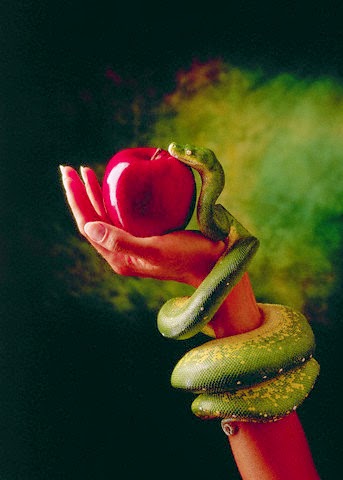
In Islam, God has prescribed boundaries for us not to cross and as long as our desires and cravings are pleased within these boundaries, it is not sinful. However, due to our negligent nature, we, humans, forget these boundaries that have been put in place for us and we begin to sin. As per the story of Genesis in Islam goes, Adam and Eve were in the Garden of Eden where they could have had all they ever desired and fulfilled their desires through those means as long as they did not eat of the fruit, this was their boundary. But, they forgot about it and fell into sin.
Now comes the idea of Salvation in Islam. A primary difference between the Genesis story in the Bible and the Qur’an is that in the latter, Adam and Eve repent after they eat of the fruit in the Garden and their repentance is accepted by God and God forgives them. This is the notion of Salvation is Islam. God forgives as long as one repents sincerely. In the end, Islam is about struggling and striving to fulfill God’s Commandments but not perfecting it because our limited, forgetful nature makes it impossible to do so. Humans are to strive to follow the Qur’an and Sunnah to accomplish God’s Command. Humans are to strive and remember God and His Laws, and resist falling into sin and temptations, but humans cannot avoid sin completely. However, this is not a problem; this is the point. Islam is about earning God’s Mercy and Forgiveness through devotion to Him, His worship and remembrance in Man’s daily lives, not about overcoming his or her humanity.

In regards to matters of belief and disbelief, Islam does not cite blind faith to be one’s mean to approach the former and dismiss the latter. Instead, Islam encourages belief through rationality. Islam holds the idea that humans are not inherently sinful by default but rather they are negligent and forgetful in nature, disobeying God’s Laws through ill memory and overlooking the signs of God’s existence via similar methods. In other words, humans forget.
Disbelief, or the act “kufr,” in Islam, is believed to be the consequence of human beings forgetting and neglecting the obvious signs present in the universe of God’s existence. Humans see around them the natural order of things: the sun rises in the east and sets in the west, the moon follows shift and on comes nightfall, specific times allocated for the two and neither clash against one another. There is a harmoniously set hierarchy present among animals of the wild and even the plants. Each celestial body – the sun, the moon, the planet, the stars – are all assigned their respective orbits and one orbit is not occupied by more than one planet to cause disruption between them. The laws of gravity are put in place to hold everything down in order. The water cycle is in balance. Even in our own bodies we have the intricate detailing of the blood vessels, the bones, the muscles, the bundles of nerves, the cardiovascular system, the digestive system with its optimum pH levels and presence of natural catalysts in the form of enzymes for reactions to take place, mytochondria in cells, minutely crafted organelles, etc. and the designing of it all is so complex and efficient that Islam argues it could not have been possible without an Intelligent Designer in charge, an Almighty Creator, One Who puts it all into motion for the benefit of us all so that we may be grateful to Him in return and worship Him. Regarding this, God, through the Qur’an, tells us in the first thirteen verses of Surah ar-Rahman:
Most Gracious
Taught the Qur'an.
Created man:
Taught him speech.
The sun and the moon move by precise calculation;
And the herbs and trees bow in adoration.
And the Firmament has He raised high, and He has set up the Balance,
In order that ye may not transgress it.
So establish weight with justice and fall not short in the scale.
It is He Who has spread out the earth for His creatures:
Therein is fruit and date-palms, producing sheaths and spathes;
Also corn, with its leaves and stalk for fodder, and sweet-smelling plants.
Then which of the favors of your Lord will ye deny?

Islam treats the issue of disbelief or “kufr” as a result of humans being oblivious to the signs around them. Similar to the excerpt I quoted above, the Qur’an mentions multitudes of times about the natural laws holding the universe in place and asking the readers if they believe have they created it all, even their own selves, by themselves, or have they come from nothing:
“Were they created by nothing? Or were they themselves the creators?”
[Qur’an 52:35]
Islam argues that those immersed in the act of kufr, also known as the kuffar, are covering up the truth. Hence, the Arabic word “kufr” being used to describe the act which literally means “to cover up.” Islam holds the notion that these men and women, the kuffar, they see the world around them, the signs, they study them, the complex workings of it all and yet they fail to see the truth or they deny it through neglect. They are unaware of the Creator. When they see the various laws and processes of the world around them in motion, they struggle to understand the “how” and come to their various conclusions about, debate and discuss over it but they fail to comprehend the “Who.”

In doing so, the kuffar start to believe that they have full knowledge of all things and they have attained what they believe through logic and reasoning but Islam also argues that the intelligence of humans is limited and thus the knowledge they have attained is not complete. It is flawed and it has overlooked some very important details causing them to travel down the road to disbelief. Eventually, this cause the kuffar to become mushriks, that is, those who commit shirk – the act of elevating a creation to the stature of God, by attributing divinity to nature believing they are self-sustaining and godlike.
“Yet they have taken besides Him other gods who created nothing but are themselves created, and possess neither harm nor benefit for themselves, and possess no power of causing death, nor giving life, nor of raising the dead.”
[Qur’an 25:3]
Thus, they commit the ultimate sin, the greatest injustice and treason possible: they live in God’s created universe, enjoying His bountiful gifts and provisions, and then they turn away from Him, disobeying Him and worshiping His creation rather than the true Lord, Master and Creator.
In order to avoid falling into disbelief, Islam asks us to seek knowledge. In the Qur’an, God orders man to, “Read in the Name of thy Lord” [96:1]. Because through knowledge humans will begin to understand the world around them, the complexity of it and the beauty of it, the intricate engineering behind it all and only then shall men and women begin to comprehend that there is indeed an Architect Who has designed the blueprint.
The guidance to learn in the Qur’an comes from God but no-one is compelled to follow it: “Let there be no compulsion in religion” [2:256]. Instead, humans are to hear of the Revelation in the Qur’an, study it, examine it and scrutinize it, test it as they please and inquire of it, until finally their reason leads them to faith. Islam believes this is the natural way because the same God did both, created human reason and sent down the Qur’an.
Islam encourages its followers to push their intellect on towards belief through knowledge and rationality. Islam asks the followers of its creed to traverse the lands and gain understanding of our world and the universe because everywhere in this universe the same truth is to be found, for everything is of one piece in God’s Design. In this way, through using our intelligence in studying God’s Revelation, the Qur’an, and the world around us, humans are asked to shun disbelief and arrive at Imaan – Faith in God, the Truth and certain knowledge, as proclaimed in the Qur’an: “The Truth has come, and falsehood has perished” [17:81].
In order to avoid falling into disbelief, Islam asks us to seek knowledge. In the Qur’an, God orders man to, “Read in the Name of thy Lord” [96:1]. Because through knowledge humans will begin to understand the world around them, the complexity of it and the beauty of it, the intricate engineering behind it all and only then shall men and women begin to comprehend that there is indeed an Architect Who has designed the blueprint.
The guidance to learn in the Qur’an comes from God but no-one is compelled to follow it: “Let there be no compulsion in religion” [2:256]. Instead, humans are to hear of the Revelation in the Qur’an, study it, examine it and scrutinize it, test it as they please and inquire of it, until finally their reason leads them to faith. Islam believes this is the natural way because the same God did both, created human reason and sent down the Qur’an.
Islam encourages its followers to push their intellect on towards belief through knowledge and rationality. Islam asks the followers of its creed to traverse the lands and gain understanding of our world and the universe because everywhere in this universe the same truth is to be found, for everything is of one piece in God’s Design. In this way, through using our intelligence in studying God’s Revelation, the Qur’an, and the world around us, humans are asked to shun disbelief and arrive at Imaan – Faith in God, the Truth and certain knowledge, as proclaimed in the Qur’an: “The Truth has come, and falsehood has perished” [17:81].
— Fahim Ferdous Kibria
Subscribe to:
Posts (Atom)